


About ten years ago, I spent a few weeks of winter on the streets of Paris, homeless. The first few days we went hungry, then we began to steal from bins.
Eventually we were so far away from participating in society that it became easy for me to see where I could find food for free. Sometimes at the cost of the people that were making and selling it. We agreed it was acceptable, given the situation.
At some point, a group of humans got together and decided that their time is best spent nailing wood and sweating into their work to build boats, so that they can leave where they are in search of resources that help them survive. It’s a good decision.
Where they landed they eventually found competition, and those ships began to carry more than objects for trade. They also agreed, it was a good decision.
Our manner of constructing a joint reality is a beautiful part of our species that no other animal on earth does to this level. Yes, the bee creates the hive and the ant creates the hill. The orca work together to hunt, and the dolphins will play in the waves. But none of them are on Substack reading an email right now from a person they’ve probably never met.
That’s kind of cool.
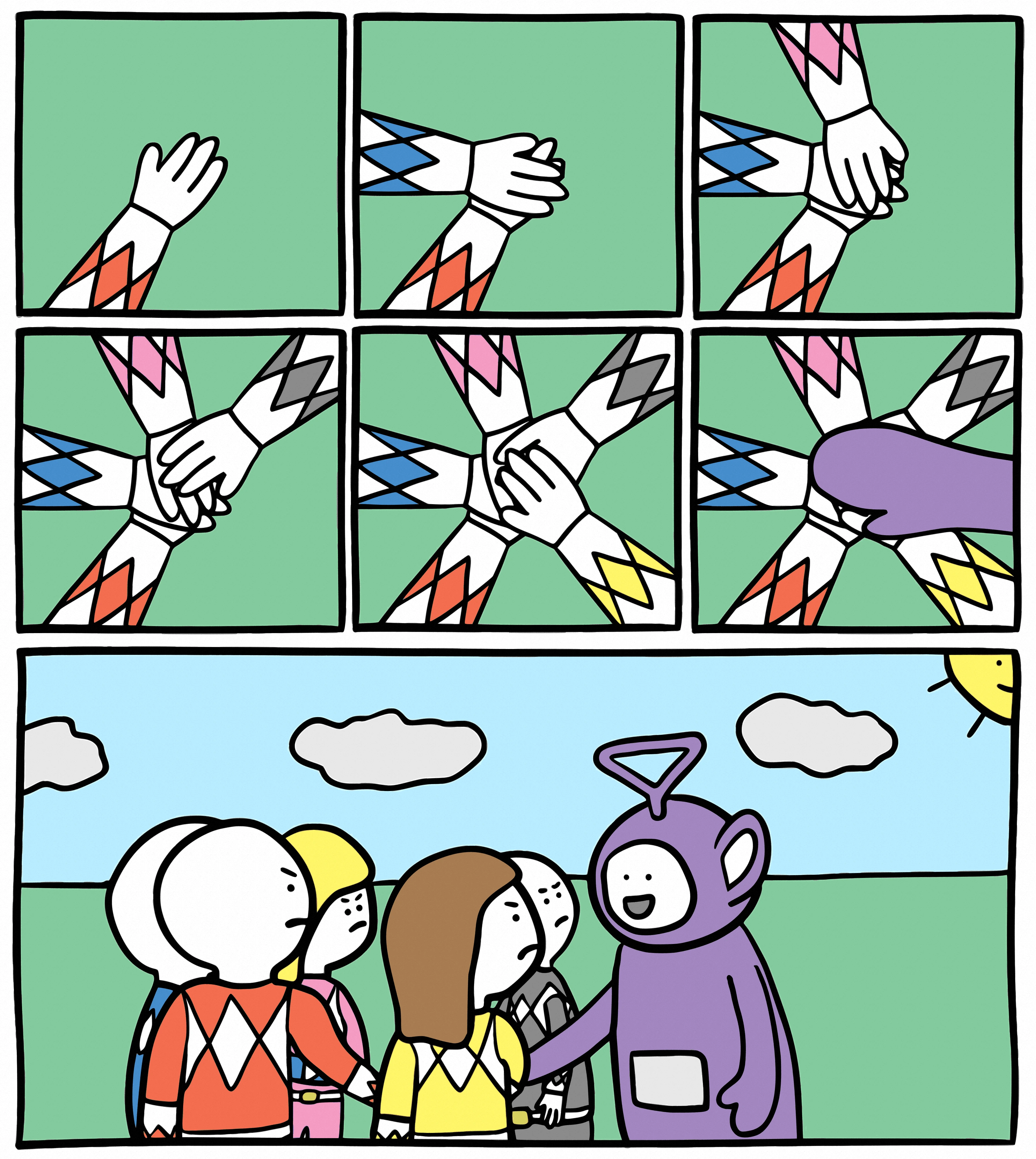
Today’s essay is about consensus reality.
We all have a unique perspective on the world, defined by how we move through it. How we view it. And the when and where. Sometimes the context to understand it can only come from those nearby. We gain agreement.
The broader the consensus, the more power it has to organise our lives.
Condition
What is it that connects the tallest to the shortest? The most beautiful to the most ugly? The richest, the poorest?
We will all experience death, isolation, meaninglessness, and freedom.1 These four conditions are baked into us all.
As we experience reality, and try to have an effect on it, and realise that nothing comes back, we feel a lack of meaning. What’s my purpose for doing this?
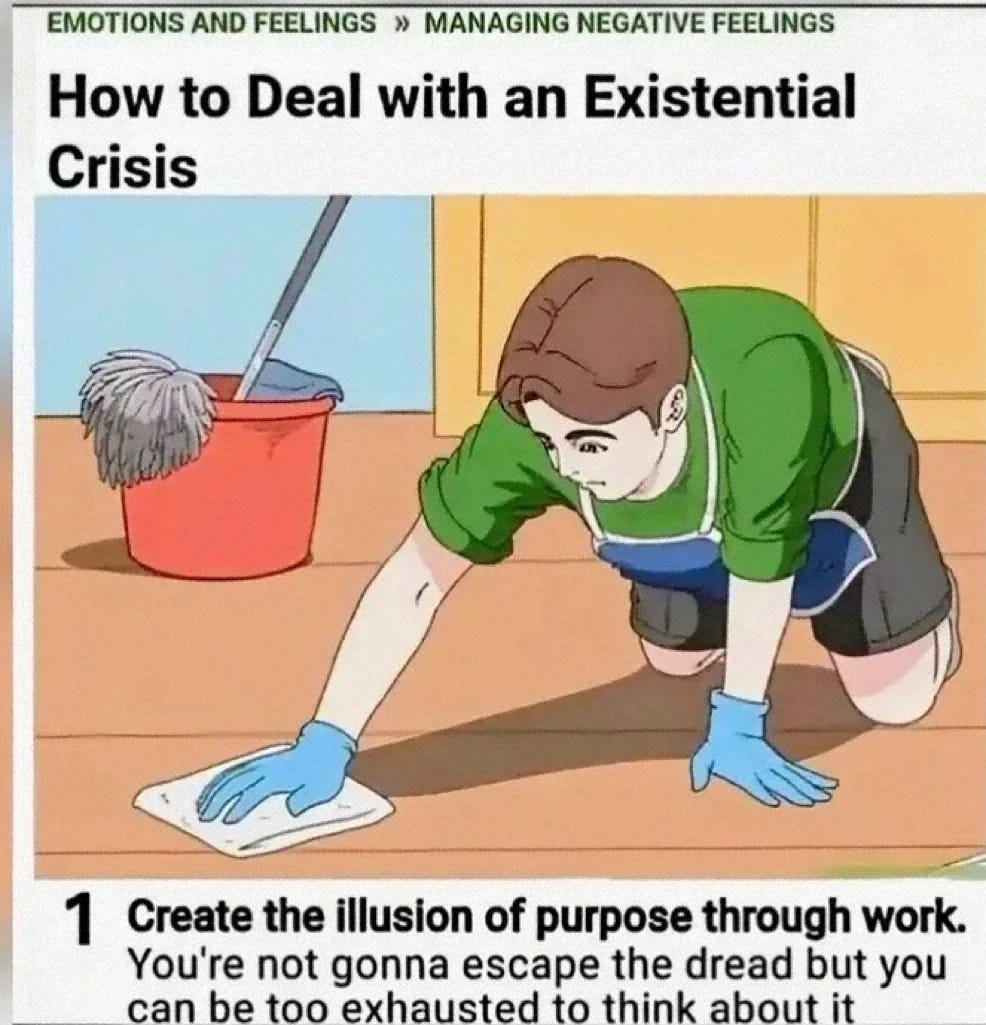
That lack of meaning slowly trends towards feeling that we are alone, and we seek others who have that same feeling. As we tie ourselves to them, we agree that the thing that none of us want is to die. The ultimate cost. And we create, in order to prevent that.
But as we become banded to one another, the things that we want to do aren’t aligned with those around us. The connections we’ve built to prevent our most carnal fears lead us to realise that we’ve given up something else that we all need. The freedom to experience reality on our own terms.
And the only way to get freer is by committing more to the group. So we commit, and eventually we extract value. So much value that we can step away from the consensus reality that’s keeping us stuck.
And once we break free, and we finally feel the freedom, we see the other side of the coin. That freedom in itself is terrifying. Once we realise we have free will, we don’t really know what to do with it.
We see the dark side of freedom and begin the cycle one more time. We move, we readjust, we reconnect. We find consensus with ever-changing groups of one another, to better understand what it is from this experience we want.
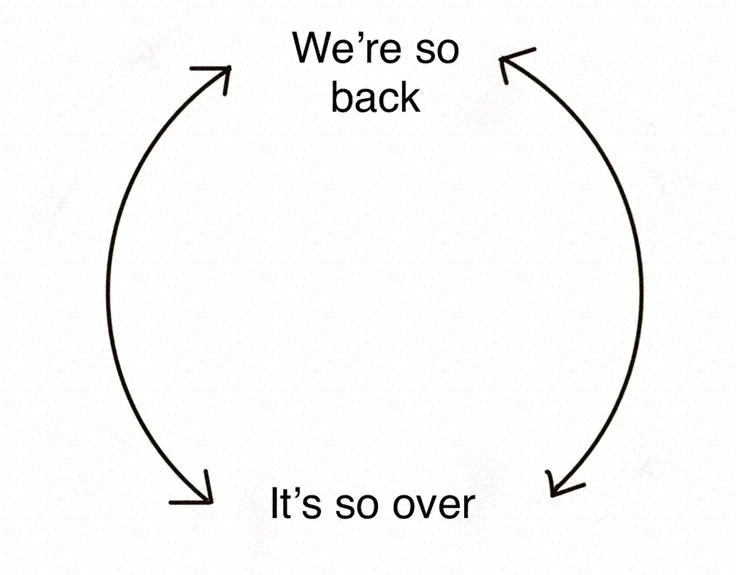
Want
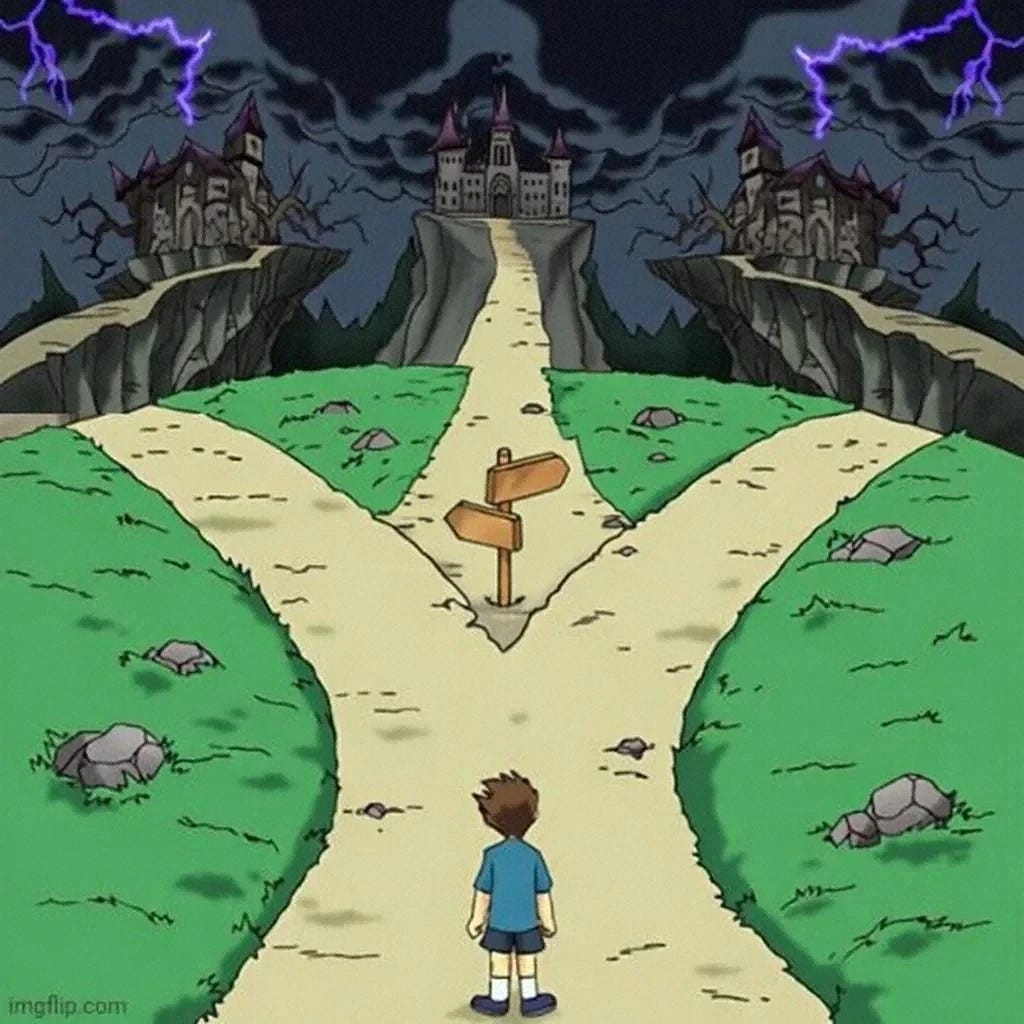
Often the lessons we need to learn are the ones that come to us when things are going well. When we think that we’re finally through the dark times. And the road forks. And neither side looks like a path we want to enter. Because we thought that what’s at the end of each of these roads came together.
And it’s at these points we have to make a decision.
Sometimes we look to those around us, speak to them, ask them. Which way do I go now? Sometimes there’s no one there. And we have to go inside.
The cost of freedom comes again. And knowing that we have no one to blame for our choices in these moments means that we’re finally defining who we want to be. Often the decisions we make lead us to becoming someone different. And we don’t know how that person will respond to the choices that this one has made.
We want to take the left path, but the right is the only one that’s open.
But seeing that the left path has closed is enough for us to understand what we want. Even if it’s not what we can have at this point in our life.
Selfishness
And the reality is that we are selfish.
It’s a heavy word, selfishness. We long to be good people. And it’s an easy perspective to take when you’re not tested. When you only see the world through a lens that can give you what you want. Which is partly the things you desire, and partly protection from realising that in a world that doesn’t have that, we would be completely different.
I’ve had the fortunate experience of living without money and living with it. Being in a safe environment and being in one where conflict is the baseline. And that’s given me the ability to see how flexible I am as a creature.
I have a good friend who talks about spiritual awakenings. It becomes abundantly clear to us as men that peace is much easier to come by in isolation on the side of a mountain. Away from the carnal delights of the cities we love and the bills that come with them.
Scarcity
No one thinks that they’re a bad person. But when there’s only enough soup for the few, I think we all know that the people around us would rather have bread and soup than go without.
It’s not a nice thing to see in yourself, but it’s real. I know now what I can become, given the right conditions.
Those moments where we’re willing to shove, steal, ensure that we survive over others, show us who how malleable we are. Some will call to the floor. Some will push to the front. Others will steal from others.
Our way of challenging those actions is what defines us as a society. Not only do we build consensus over what resources are available, but we find ways to bring to justice those that challenge that.
We can create a rule to stop the strongest person taking all the soup, but a rule can also be used to hold the soup for the people who can write the rules. And isn’t that just the same as shoving? Instead of using our physicality, aren’t we just using our mind?
Incentive
We’ve known about consensus reality for a long time. The media environment we exist in is reliant on creating these coherent ideas of consensus. The earlier systems for this are the feudal systems and religions. A set of rules by which, if everyone lives together and works by them, we survive longer as a species.
We all wear clothes, generally in a way that helps us be identified for our role and function. We all go to work at the same time. We all agree that certain laws work well. All of this creates a functional civilisation within a given environment. Whoever is running the environment gets to shave the value off the top.
But they’re incentive systems, irrespective of their scale and value. They’re designed to make a group of humans behave coherently for the betterment of one another.
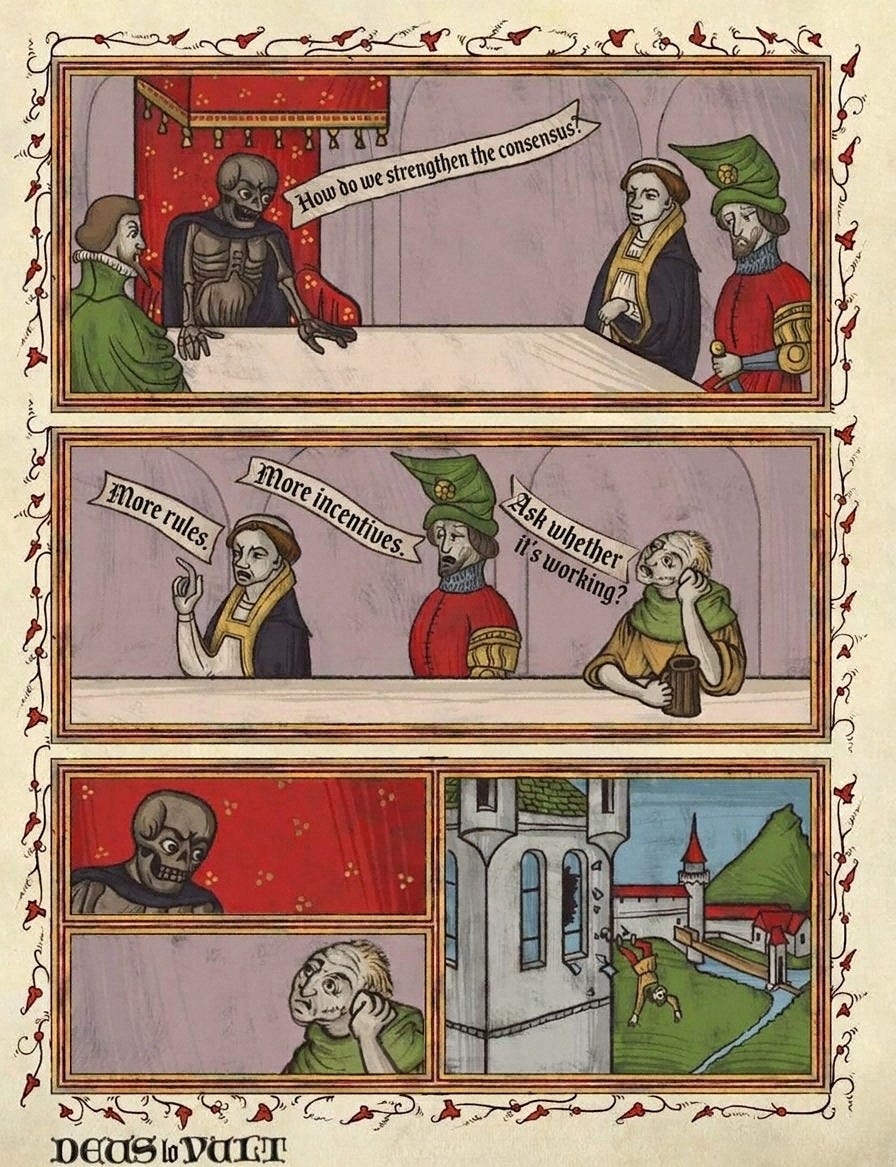
Those that commit to the consensus seek to benefit from it. And although sometimes those decisions are made with the best intentions, it’s often because the costs of these decisions aren’t borne by those that make them.
Culture comes from these consensuses. Actions that we perform together to show that we are aligned. That we understand what the agreements are between our groups. And the incentive structures for people to show that they are part of the consensus are a method of control.
It always benefits the incumbents. And they made the decision long before they took into account who you were. Or who you want to be. When I was stealing food in Paris it only existed because other people had worked to produce it. Breaking the rules around me didn’t suddenly make me independent.
Only the four parts of the human conditions and laws of physics lack incumbents. Nobody made those decisions. And therein lies the difference between culture and truth.
Interrogation
I believe that life gets better. Year on year on year on year. Humanity wants to improve.
And I don’t like the narrative that certain artefacts people have created are purely evil.
The most heinous things we’ve done as a civilisation have been done in the name of good.
In the art world, we tend to demonise. We’re left-leaning and collaborative by nature. We want to see things from different perspectives; we want to welcome other views. Just not dissent against our median idea of what our culture represents. A lot of the time, the most far-reaching and powerful structures of society are the things that we demonise.
But that doesn’t mean they shouldn’t be interrogated. Used, played with, critiqued, messed with. That work can’t be done from afar. I think art develops society through this. Through testing the borders of these things. To understand what humans are like within this system.
We all live within the system of fashion. I don’t think I’ll ever stop being interested in how our aesthetics can redefine who we are internally and how we’re perceived. But the more powerful forces exist within the industries that have the highest concentration of capital.
If there’s one thing I’ve learned for sure, it’s that even those that we think have good values will still choose money, because they’re not secure enough in themselves to think that they can get beyond it. Being able to risk it is a high bar. I know I’ve set it for myself. To expect it of anyone else would be unfair.
Money is real. Not everyone wants to live a life of freedom beyond the constraints of consensus reality. Some people just want to be rich and think that that means they’ll be enough.
Consistency
I probably have an unconventional view of what artists are exploring. If you look through the lens of who they are as a human, deeply, you can’t disconnect the artist from the art. Not in the truest sense of art.
There are painters that are exceptional painters, and they paint. But there are also artists that are living in a certain way that is consistent.
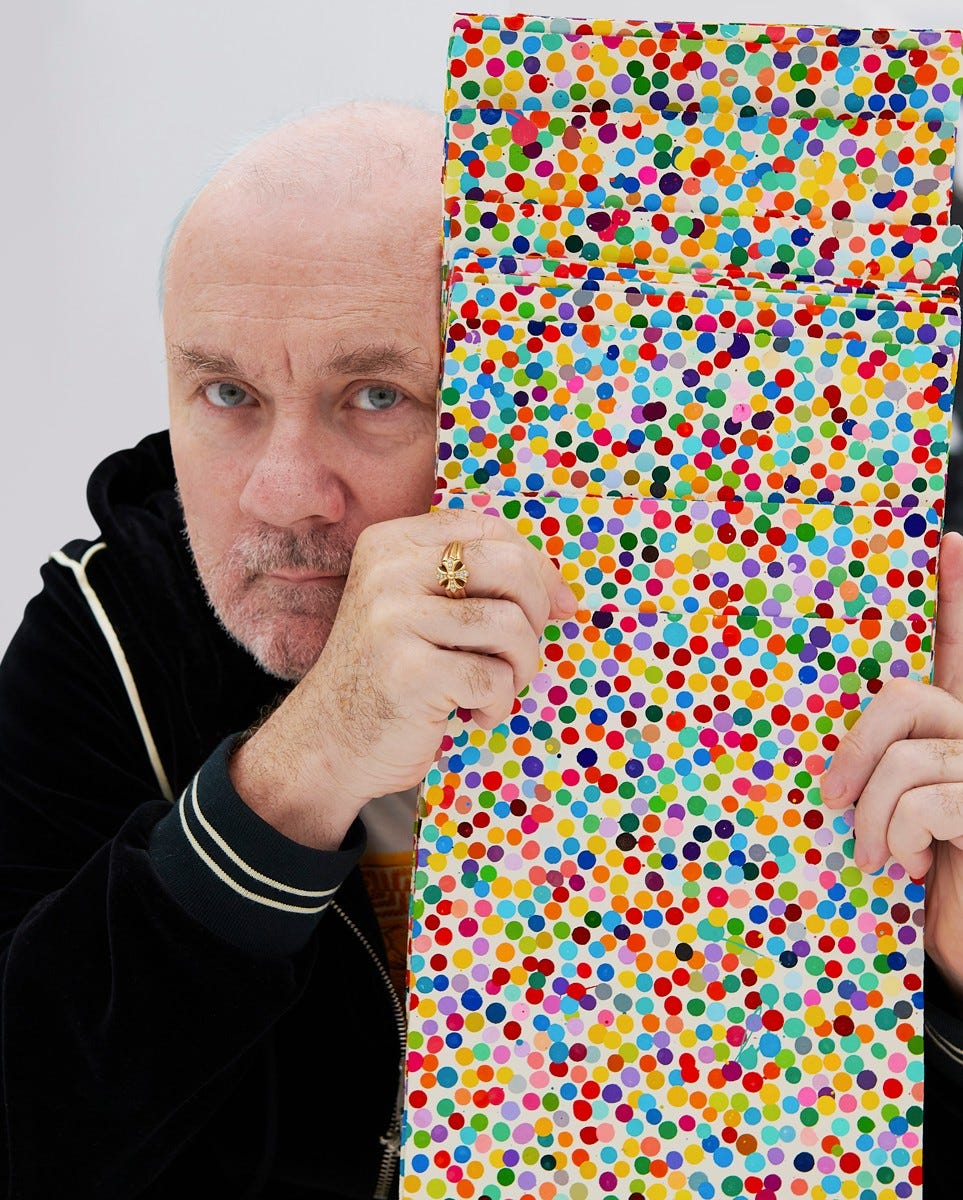
When I look at Damien Hirst’s work, it can be easy to decry it. But I think it’s a human in a phase of society exploring their relationship with wealth. How do I make money?
The 2008 Sotheby’s sale2, going straight to auction. His playing with pricing structures. The Currency3. It’s clearly a person obsessed with understanding the financial engineering of art. And when you take that perspective on his practice, suddenly, it’s not that important what he’s making, his painterly ability, or his use of other people. What you can learn is how he sees money and art sharing a bed.
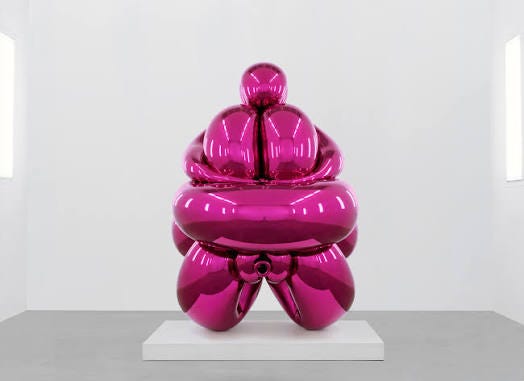
I think Koons is exploring the idea of the corporation. The product. The deal. It’s so aligned with the American market during his tenure. His structure for projects. His ability to raise capital to create things that are far beyond the production capabilities of conventional systems. These are done through structured investment deals. Even in his most modern work, it’s clear that what he’s creating are things that nobody else can create4. The game is the spectacle sold as a deck before it’s made5. That’s where his magic lies. He knows how to make a good deal and bring those teams together.
Maybe the artist is better defined by what is driving them than by the physical artefacts. Even if that is something we don’t like the look of.
Border
I got the chance to see one of my favourite collectors yesterday. And they said something to me that gave me a little bit of belief in myself, in a time where that’s a little bit difficult.
They said, “I don’t see many artists that are living what they’re researching and understanding as deeply as you.”
I’ve seen many. Sophie Calle is probably my favourite. Someone that desires to look and see. A voyeur. A spy. Her life organised around the idea that what she wants is the perspective and then recording that and sharing it with all of us.
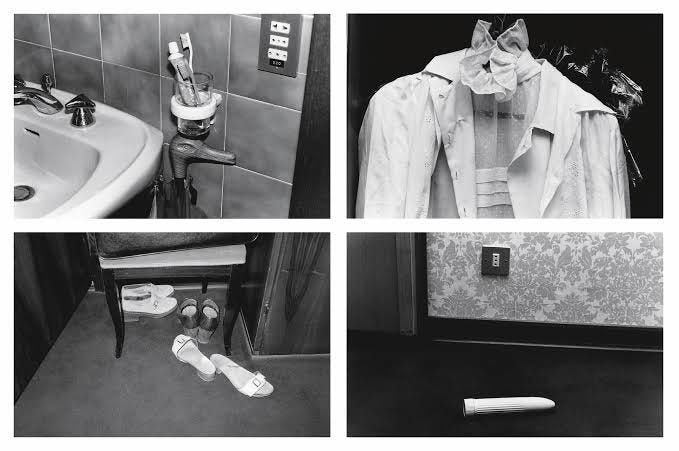
I’m just getting to that threshold of my life now. Where the people I meet know the artist before they know me. And I’m not sure whether there’s a border between them anymore after last week. I think that’s the decision I made. The door to whatever I once had has closed. Now there’s only me and my work.
The ego has become persona, and I’ve created a place where I feel free, but it’s also a prison made of my work. And if everything is now up for interrogation as if it’s work, that can create a level of mistrust. I’m upfront in what I’m interested in. Freedom and control. The malleability of our identities. And to a certain degree, that means that everyone that interacts with me knows they’re part of the game.
I have someone new working in the studio. And it’s the first time that I’ve been able to show the depth and darker side of my studio practice without the feeling that it mattered what they thought. It’s a scary place to be, working for an artist like me that is playing with these things. I understand that. But I tried to show them as much as I could, and the response I had was one of the most helpful feelings I’ve had in a long time. To see someone believe in what I’m doing, and offer themselves up to it, may result in this being one of the most important things that’s ever happened to me. Or it may not.
I’ll keep the story for another time, hopefully far in the distance. I’ve learned recently that it’s sometimes best to see how things end before they’re shared.
I would hope that some of the interactions I have are altruistic. But what I know about consensus reality is that they’re probably not.
Final Words
Next week we’re going to talk about how consensus reality relates to culture. Something that I believe art should not exist within, in its truest sense.
There is art that comments on culture. At its lowest, smaller cultures. Marketing for a company. Art direction. Brand ideas. The stuff that flies across the internet. Higher above, national identities. What it is to be a gender. And going beyond this, what it is to be human. And ultimately what is, and what is not.
If there is some hierarchy to the level of introspection that an artist can take on, it’s by examining these higher-order effects.
I have an open studio next week, and hopefully I’m going to be ready to show my first interrogation into tech culture, or at least the first phase of it. I haven’t put stuff out on the street for a very long time, because I really wanted to understand how fashion and art collaborate sustainably.
Next week, when I talk about culture, I’ll close up that work by talking about fashion. How does art integrate into the culture of fashion? I believe that some of the larger houses understand it, while some don’t.
If you like ideas, and want to talk, especially if you want to see deep into the rabbit hole of what I do, I encourage you to come next
Saturday 26 September from 2pm.
I’m at 89 Albert Embankment, SE1 7TP.
Search Russ Jones on Google Maps and it should come up.
I would love to meet you.
The only thing that I can promise is honesty.
Ask whatever you want.
I want people around my work. I don’t see freedom as the absence of people. Perhaps it’s closer to hearing what you think without needing to agree before I move.
I’m doing this because I enjoy it, and because I want to find out where it leads.
It just might not be the answer that I want.
I love you loads,
Russ x
The four conditions are from Irvin D. Yalom. He calls them the four ultimate concerns: death, freedom, isolation and meaninglessness. They’re from Existential Psychotherapy (1980). Yalom sees freedom as a burden. The fear caused by knowing that every choice is ours and we have to live with that. What I’m looking at is what we do with it. We hand it to the group. Then we want it back.
Hirst’s ‘Beautiful Inside My Head Forever’ ran at Sotheby’s London on 15 and 16 September 2008, went past his galleries straight to the public, and raised £111 million.
The Currency launched in July 2021 as 10,000 NFTs matched to 10,000 paintings. Holders had to pick either a physical or digital version, with the other being destroyed. 4,851 kept the token, and those paintings were burned. Tokens were $2,000 each.
Moon Phases is 125 one-inch steel sculptures that touched down on 22 February 2024 aboard Intuitive Machines’ Odysseus. It is the first authorised artwork placed on the Moon.
Koons’s dealers funded Celebration partly by selling works to collectors before they were fabricated. Balloon Venus came about from similar arrangements. It’s good economics in an industry plagued by the opposite. Also worth noting a lot of these deals have taken 10+ years to turn a profit and often rely on the secondary market picking up the slack.