The birds are eating the flowers.
They always do.
Tulips and crocus are easy targets.
Finches love them.
I wish it was hummingbirds in the fuchsias and honeysuckle,
but the sparrows have found their way here.
That’s not to say I don’t enjoy the trade.
Colour for sound.
Maybe they know I’ll accept the deal.
Sometimes
I think about making a garden just for them.
Erewhon for the birds and bees.
But if I get too many in the garden,
it’s hard to control,
and eventually
I get overrun by pigeons.
So for now,
it’s just enough to curate for the best.
They see what I’m doing,
and they keep it quiet enough
that the masses don’t swarm in.
I have colour when I need it,
and sound when I don’t.
The garden’s always been mismatched,
but I feel more at home here than I do inside.
And both are better than everything out there.
Something about walls never sat well with me.
No matter how much I do to them,
they never feel like mine.
I guess it’s the same here,
but the flowers and I have an agreement.
Unwritten,
sure,
but irrevocable.
I keep the engine going,
and they keep me company.
I know what you’re thinking.
They don’t have a choice.
But I do.
And maybe that’s what I like.
Hello World
Welcome to HGLA #114. There are a lot of new readers here, so over the next few weeks, I’m going to show you behind the scenes of the different arms of my practice. Partly as a reintroduction, partly to tidy up what I’m doing.
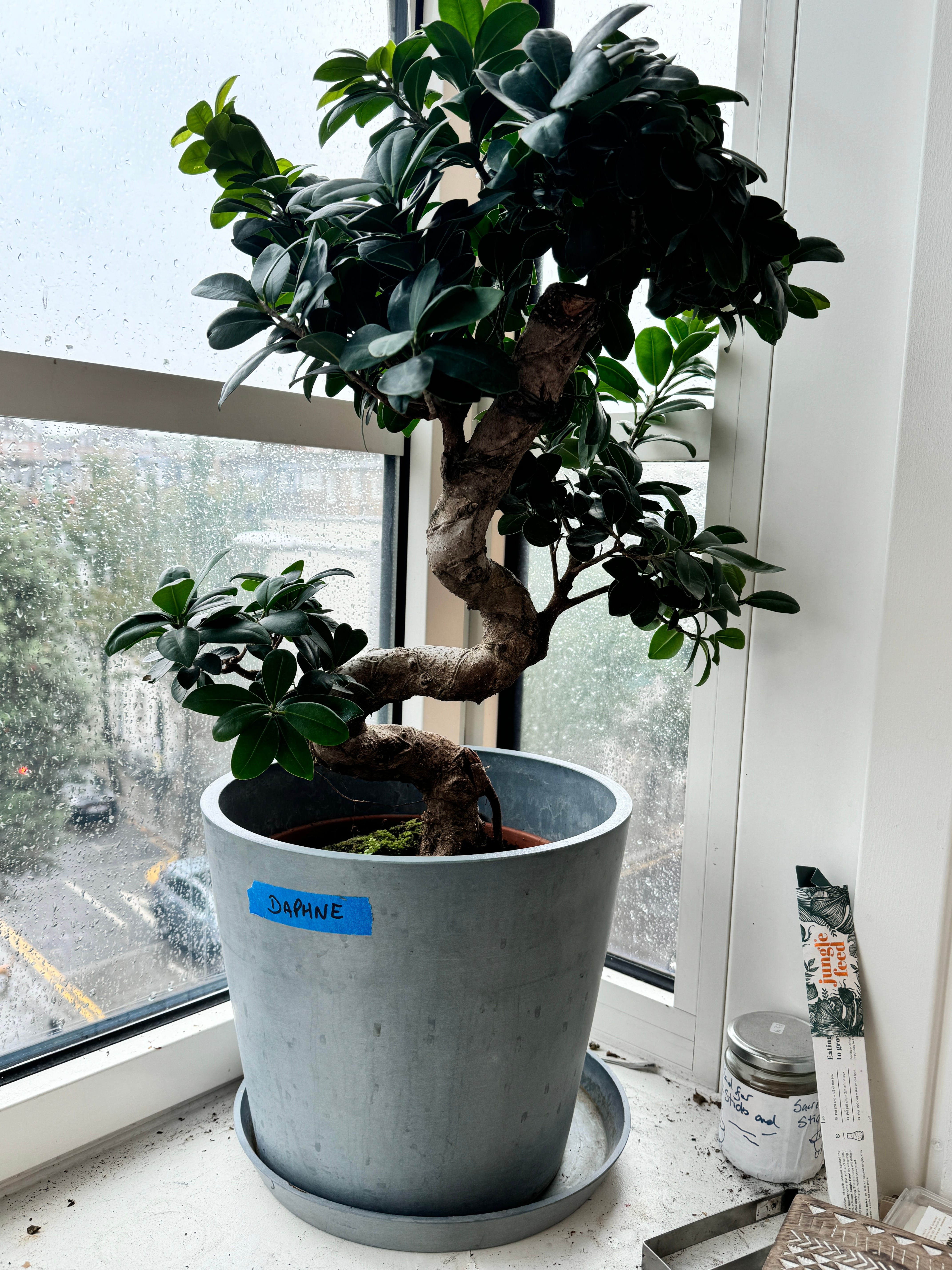
I’ve just moved into a new studio, and anyone who’s visited will have met Daphne, my bonsai tree.
I love gardening and flowers. I’m always learning about myself when I do it.
Daphne has spent the last two years growing with little regulation. Her roots are strong, she’s been trimmed to stay neat, but her overall composition wouldn’t win any favour amongst a critical crowd.
I know she needs more structure, but there is a fear present whenever I cut her back, whenever I look at shackling her in copper wire.
Why the hesitation with her? Why the hesitation with my practice?
Most of you know me through my writing and street installations, but my painting and conceptual practices are where I get my real work done.
The Garden, Daphne, and my practice share a lot in common. I’m interested in systems that look like freedom. We often think we’re choosing. But there’s always some greater force deciding what gets planted, what gets eaten, and what’s left behind.
Layers
The best way to understand how my participatory work operates is through three layers that work simultaneously at different levels of abstraction. This is what makes the work survivable in the public domain.
Surface accessibility
Someone walking past who knows nothing about my practice and doesn’t understand the history of art just thinks, oh a weird object and I can draw on it. That’s a trick. I’m making it look simple because, at this point, I’m really interested in the volume of interactions and reducing the barriers to participation.
Particularly, I’m interested in the memetic elements of participation: How many people can I get to interact with something by making it look crazy and fun? Can I get them to copy one another? Can I fill up the whole wall?
Engagement Mechanic
This is where the prompts, surface, and pens do the work: What feeling am I trying to create?
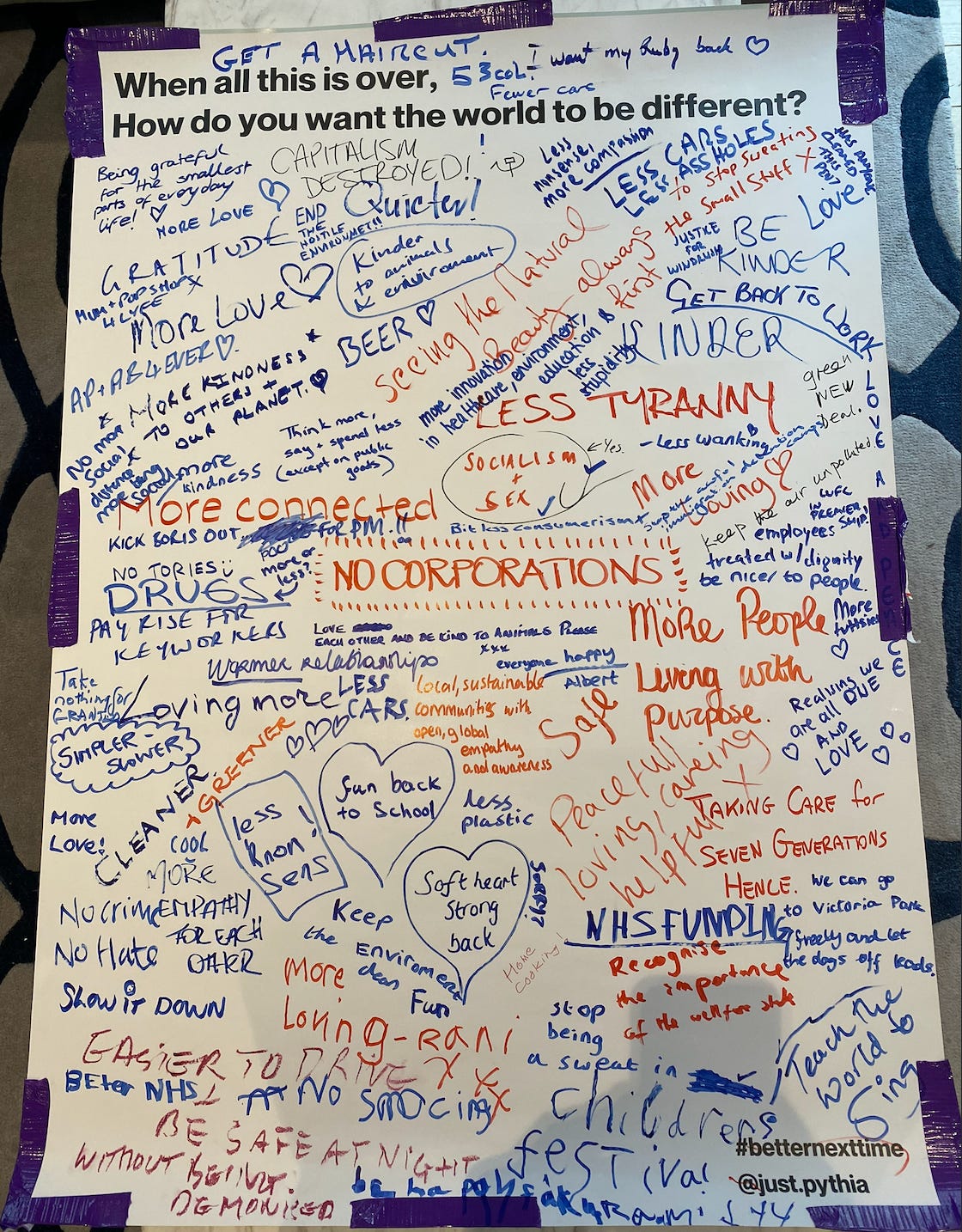
With Better Next Time, I was creating a sense of freedom about what we could do during COVID while everyone was trying to navigate what might happen.
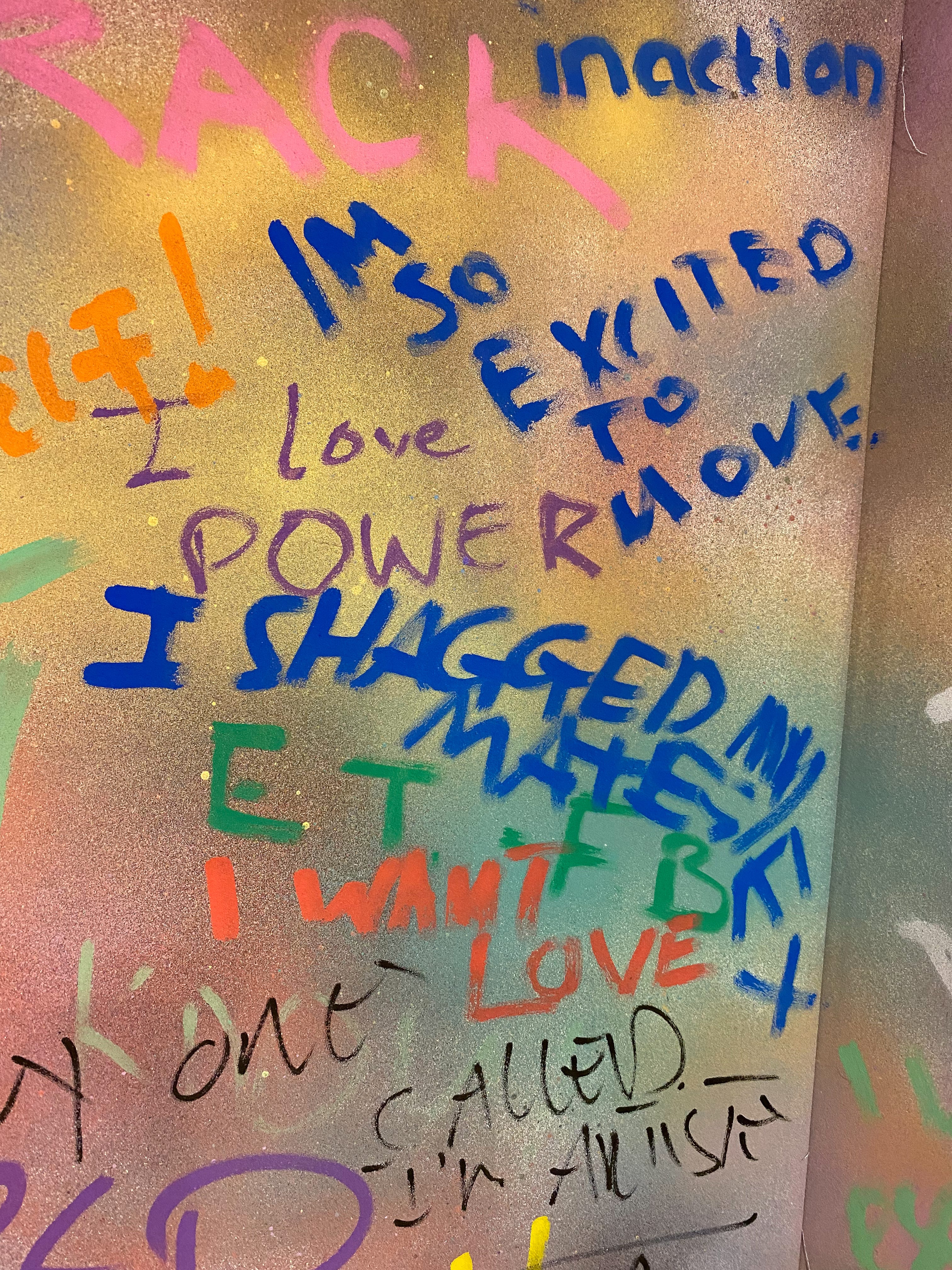
With confessionals, I’m using anonymity to enable greater depth, a mirror installed alongside to promote accurate self-image, and then using all these responses from everyone else to create social pressure that it’s acceptable to go deep. A confession booth where you’ve got access to everyone previously means a high bar is set. That could be crushing for you, or not.
With Reflections I, the prompt had to be defensible enough that a real estate developer would actually let me install it, and the pens big enough to cover 24m² before the developer realizes this is crazy. All while giving the wider public something visually interesting to play against.
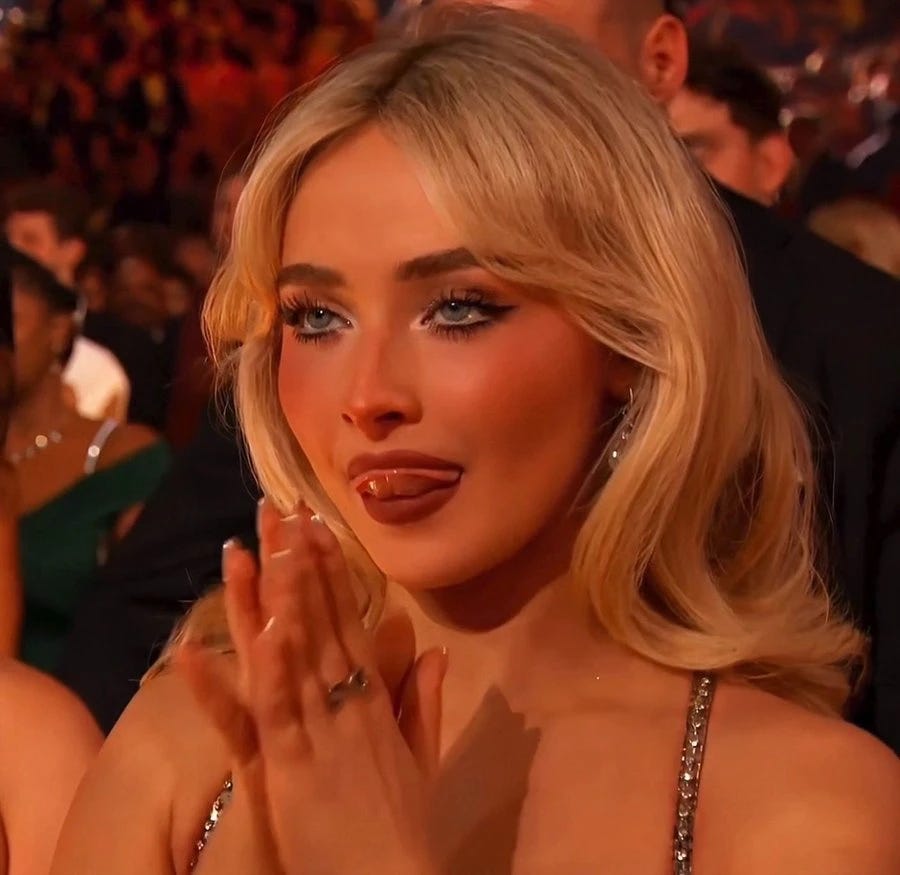
Final artifacts
This is the layer where I’m really interested. What can I do with that massive data input to create something coherent afterwards?
Something that isn’t just “here, these are the interactions that have happened.” I think some amazing people’ve done that (Candy Chang, Yoko Ono), but in 2026 it’s kind of obvious what’s going to come out as soon as you look at the idea and material list.
In my work, I’m trying to introduce a huge variability to play with. That’s where the edge of this part of my practice is. The ordering of the chaos.
The game
I’m kind of saying “Hey, come play on this,” but the reality is I want to see what I can make happen with the simplest cues.
The projects never make money. They lose a ton. Always have. Generally, because the fines and mediums are way more expensive than I expected, the scope grows, and the costs spiral.
But the value I get in terms of growth and understanding how people interact with each other, and how I’m learning to refine that collective noise into something aesthetic, is improving fast.
I’m only a few iterations away from something really stark.
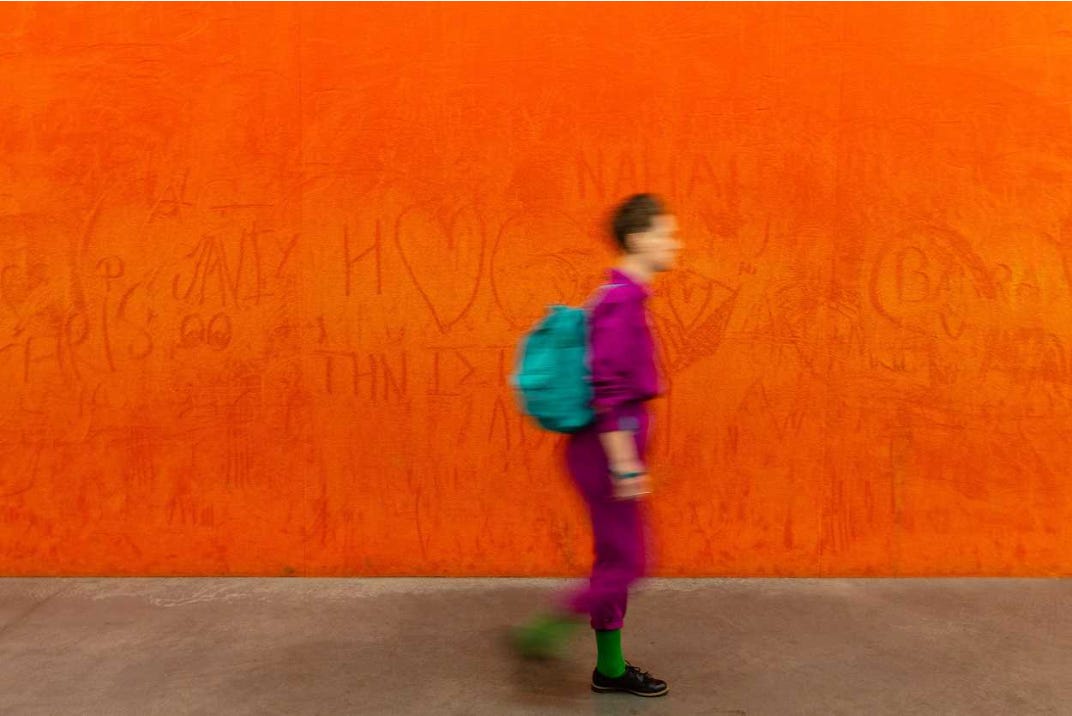
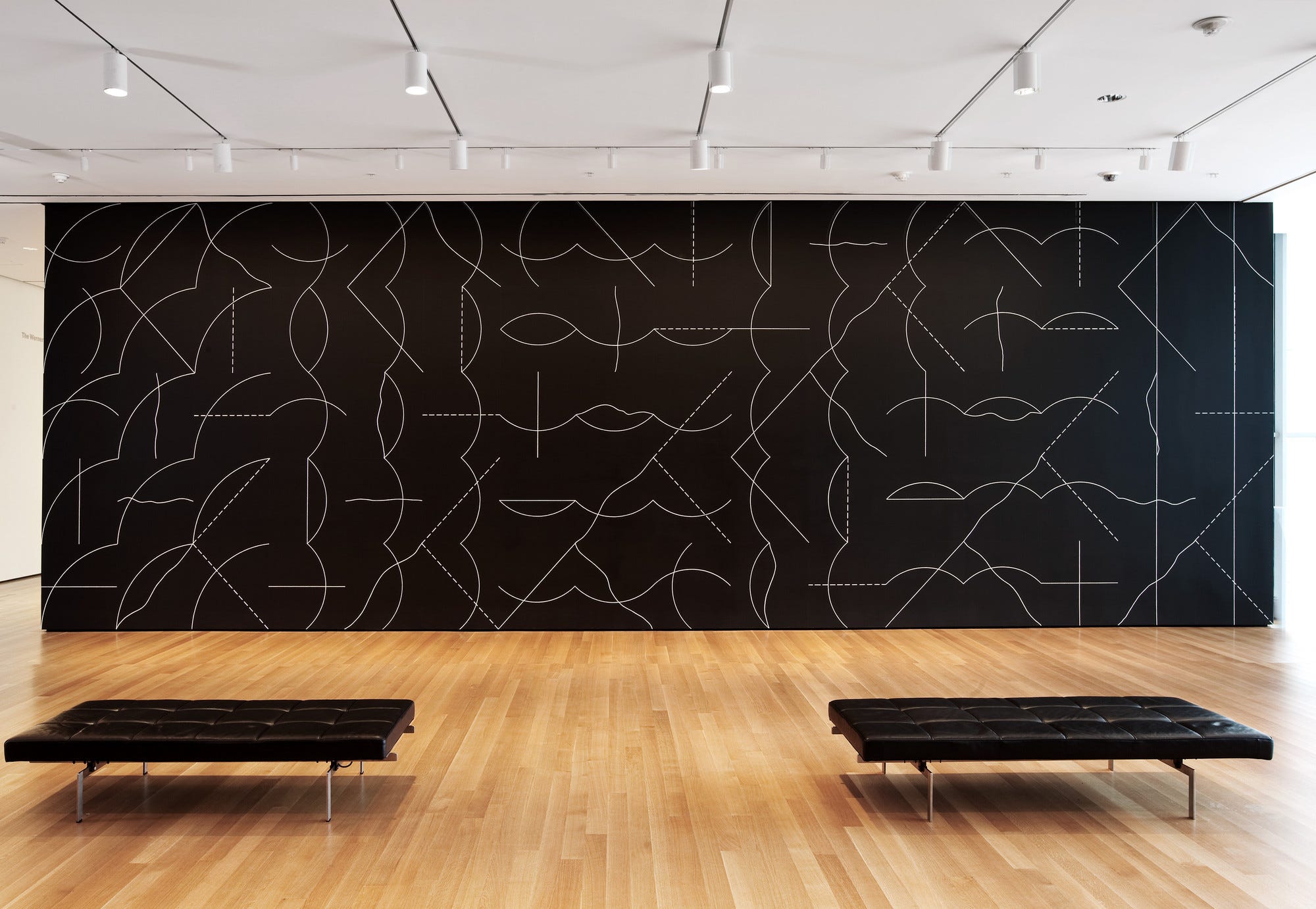
I don’t have a minimalist approach like Stingel. My rules are much more open compared to LeWitt. And I don’t think there’s any real value in looking at the results of asking a nice question on a board, 90% of honest interactions don’t answer it anyway.
So I think it’s better to force or explore the interactions you’re really interested in.
For me, that’s color, control, aesthetics, and the nice question is just a function to get interaction, so people think “oh this is nice, I’ll play.”
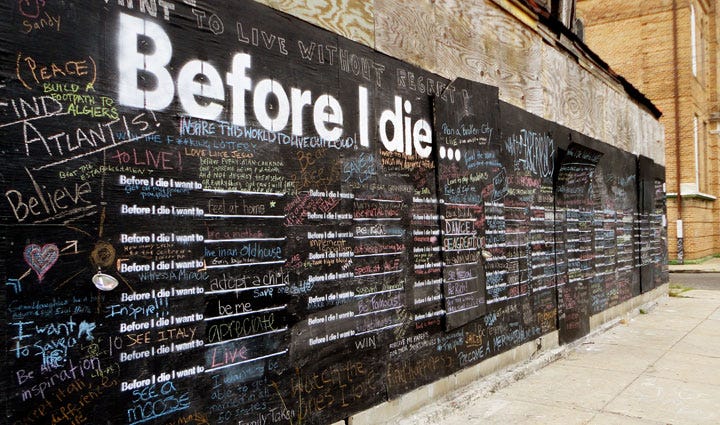
I actually love Candy Chang’s Before I Die walls. There was one in Wolverhampton in 2021, and that city has a lot of heart for a place that isn’t swimming in opportunity. It was beautiful to see. But with her, Ono, and every art school student who’s had this idea of putting a question board outside, in this format, it’s kind of done or just a content play.
For me now, the question is more about: can I fill this wall, fast? It’s closer to the ideas in modern consumer technology related to scale.
The world has learned a lot about memetic desire and exponential growth in the years that precede my work. I have too. So can I do something that creates the same curve of interaction and then process that volume of creative data so that the end result is closer to what you’d expect to see in a gallery? Really mix up the artist and viewer roles until it’s completely blurred.
Censorship
Right now, I’m really interested in censorship. In the west we promote this idea of free speech because, to some degree, it exists. The problem is that the system we live in all have some level of censorship embedded. Academia, political institutions, and industry incumbents do this naturally to protect their market share.

That’s what Reflections I essentially is. It’s me setting up a censorship system with decals and chained pens. So when people interact, I already know what’s coming out. They can have full freedom in the moment because they don’t see the system. But in reality, I’ve already cast the veto on their work. The edits are prewritten.
If I’m honest, I should have done a better job. But the reality is it worked. Nobody saw it. And it’s just the start.
It’s a 2.4-meter aluminum cube covered in decals with prompts that invite participation. People write, draw, and interact. Then we peel the decals away and reveal mirrors underneath. What you thought was your contribution becomes a reflection. The work everyone made was always going to be edited by the system I built. They just didn’t see know it.
The flowers don’t have a choice. But I do. And maybe that’s what I like.
Next week
The painting practice, the street interventions, the installations, the writing are all adjacent testing grounds for the same ideas. Over the next few weeks, I’ll break down each arm of the practice and how they connect. How the Vogue mirror series came about. How Dreamland translates these ideas into a digital space. And, I’ll also get myself confident enough to share two new series of paintings I’ve been working on for a few years now.

Hopefully, the context between then and now, and across the portfolio of work I do, gives you a bit of insight into what I believe a modern art practice can look like and where I think it goes.
Also, Daphne is getting cut back,
wish me luck…
love you loads
- R x