


I’m sitting with my back against the subwoofer
and I can feel my guts shake.
I thought I was coming to a concert to listen to music.
My ribs, hips and stomach are vibrating.
This isn’t how I listen to music when I’m walking around.
It’s certainly not how I listen to music on the bus.
Until today, I thought listening was something I did with my ears.
But I don’t think I’m using them anymore.
And for the first time in my life,
I think I’m hearing music as it’s meant to be heard.
The colours are more vivid than anything I’ve seen before, but I am sober.
I look up and I can’t quite process what’s happening.
I’m at capacity.
It’s too much, and I know that as soon as I get up it’s going to be too little.
I can feel it all over me
In my fingers, my toes, and now in the way my hands are pressing into the floor next to me.
I like this.
This is how I listen to music from now on.
Dresses
Every few weeks, I go on a magazine run. I flick through the editorial, fashion, art and culture magazines I find around town as a way to keep myself somewhat aligned with reality.
Every year, I buy a whole bunch of them, cut out what I like and make a mood board. Mainly so that Oprah Winfrey smiles on me from above.
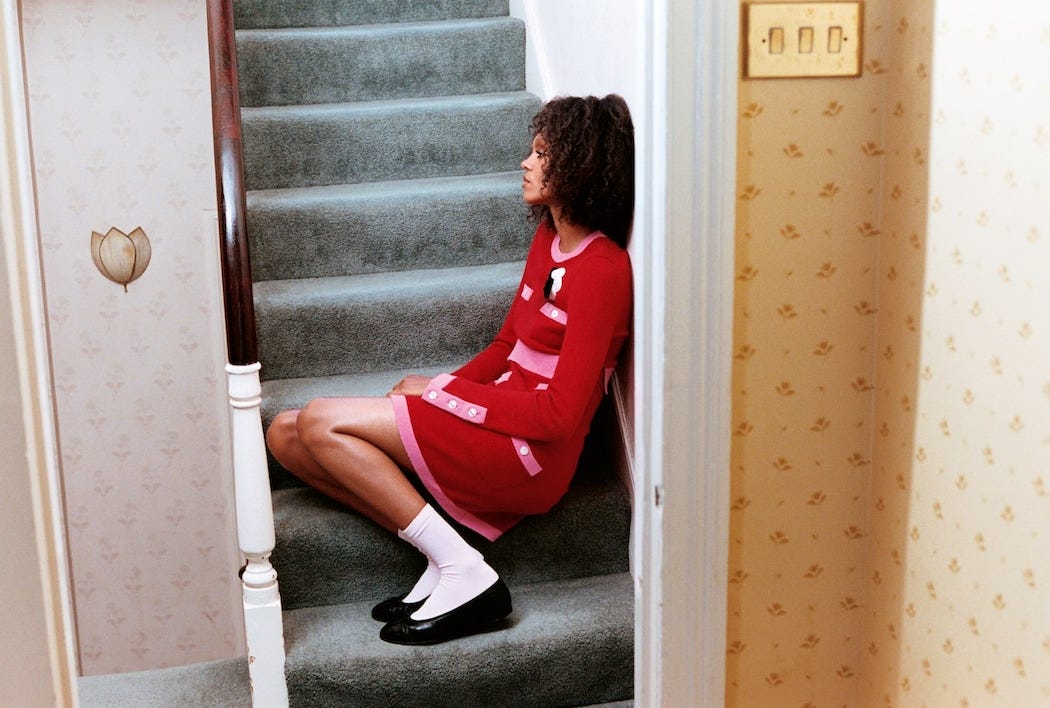
What I’ve realised is that the dresses look amazing.
Unusually for a pretty dudey dude, there aren’t many aspects of male fashion that I like beyond tailoring, which isn’t really helpful for how I live.
But what I do love, is a beautiful dress.
What’s interesting to me is how our perception of dresses changes as we encounter them in different arenas.
The first time I see the dress, it’s implied that it has certain characteristics.
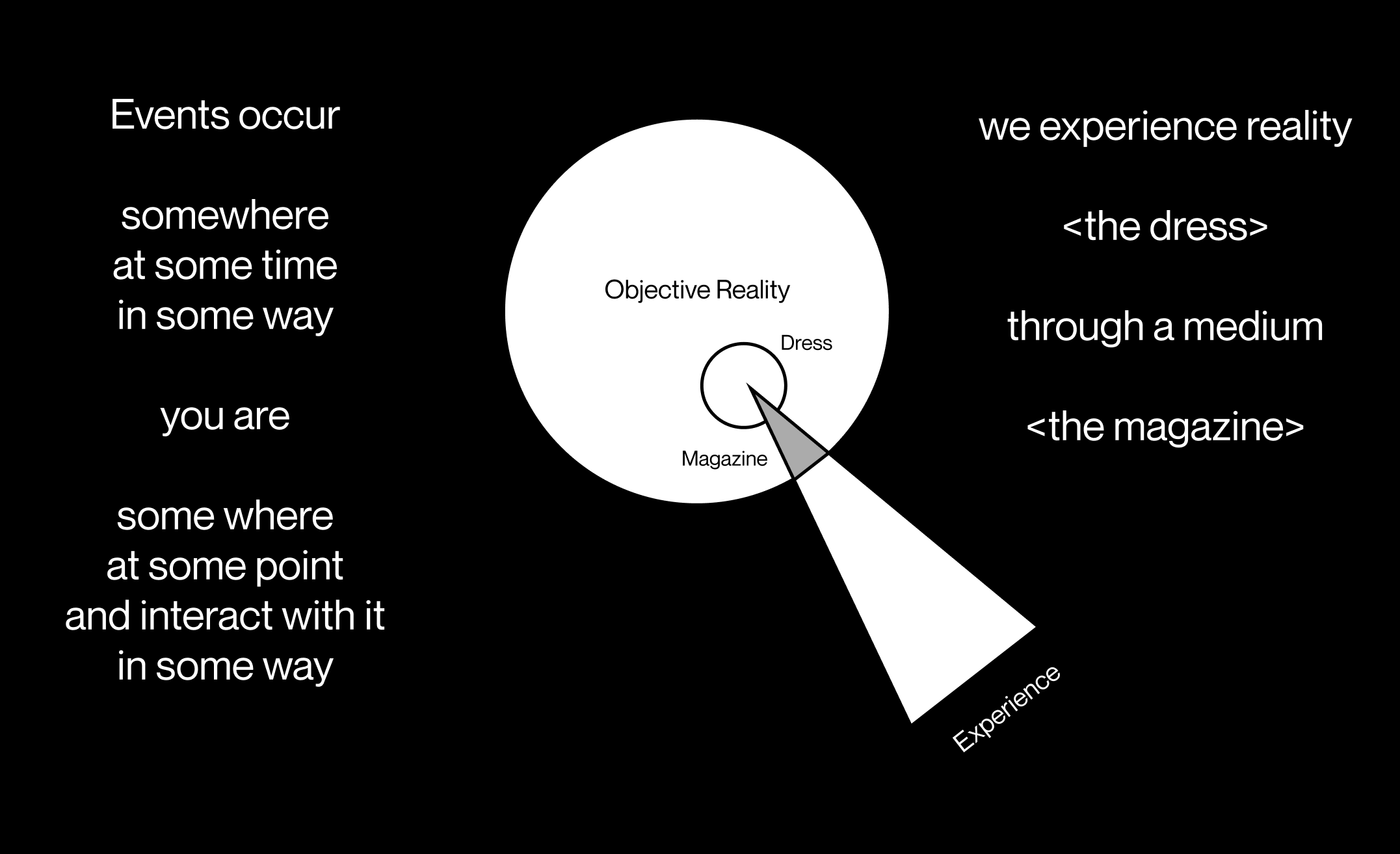
I know the dress exists somewhere in something. But as soon as I’ve seen it, it takes on all the attributes of the magazine’s presentation: the model, the shoot, the lighting, where I’m sitting, the magazine it’s in, the texture of the pages it’s on, the neighbouring pages around it.
Its characteristics are implied not just by this, but by the logo slapped on the page next to it.

Reality exists. But our subjective experience of it is always relational and partial.
That’s not to say it’s false. It’s just a thin sliver of what is actually happening. Tinted by everything around us and whatever our minds are absorbing alongside it.
Whatever objective reality is, as limited fleshy beings, we only ever get a certain cut of it.
Partial. Filtered. Relational.
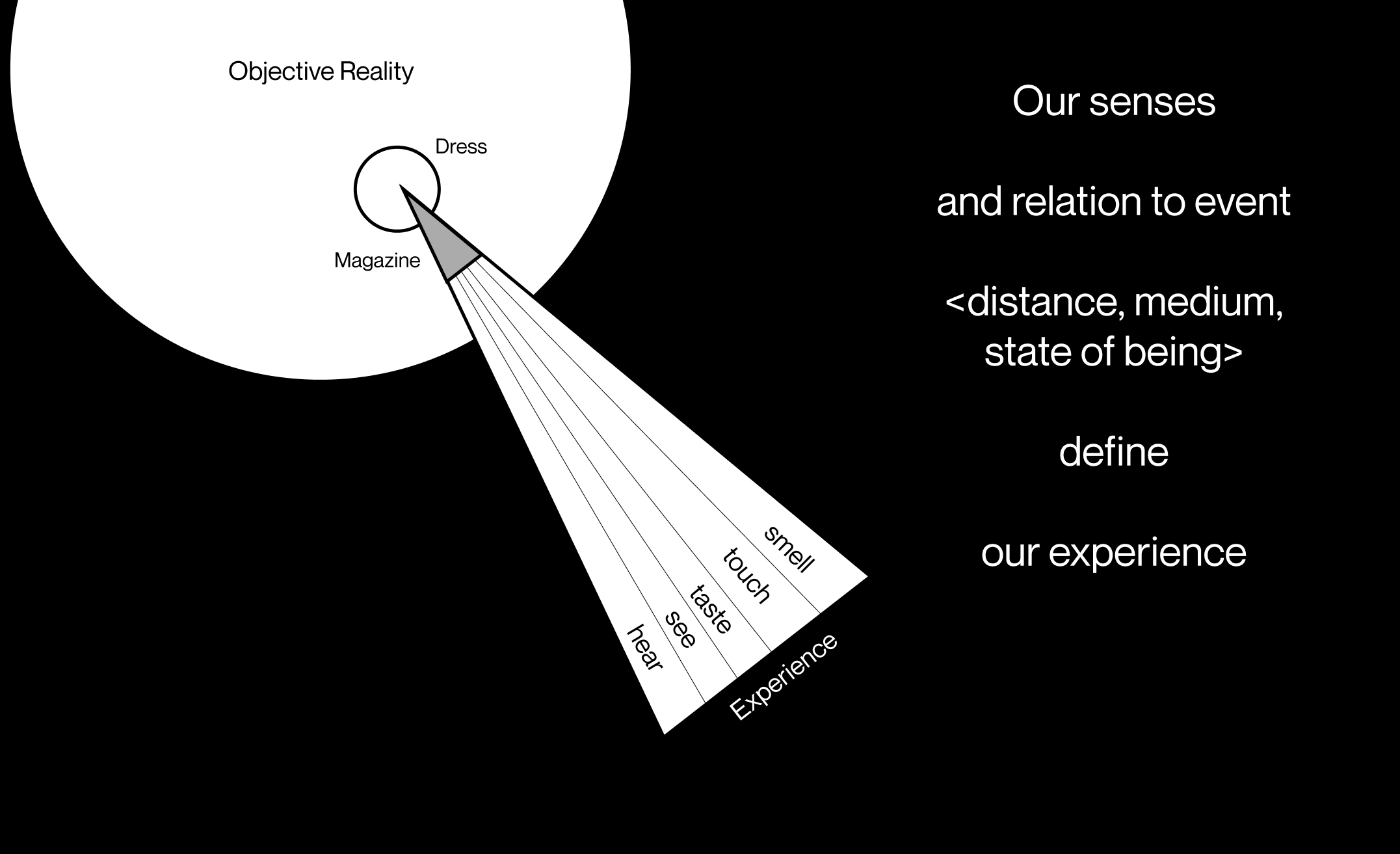
For every what that exists in the world, there are countless ways to interact with it. What we experience is tinted by where we are, when we are, and how we interact with it.
My experience of staring at this dress right now is distinctly different from looking at it on my phone later today.

These are many different ways to experience the same what.
When we change our sensory environment and how we engage with the world, our relationship to it changes too.
Were I to try and experience the dress through taste, by eating it, I would realise something about it that very few people would understand. But I would. And my relationship to it would change both me and the dress.
In 1969, Alvin Lucier made an artwork called “I Am Sitting in a Room”. He recorded himself speaking in a room, and then played that recording back into the room, recording it again. The process repeats until the resonant frequencies of the room dominate the recording.
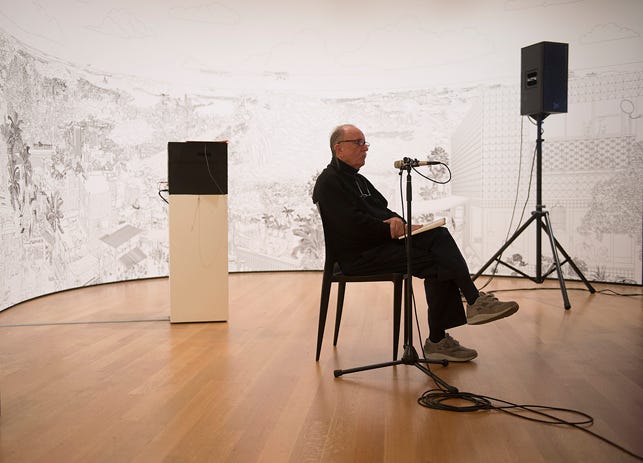
The environment isn’t just the background. It is part of the signal we process.
And the closest environment that distorts the signal is ourselves.
As we take on new positions from which to observe the same thing, we begin to learn more about it.
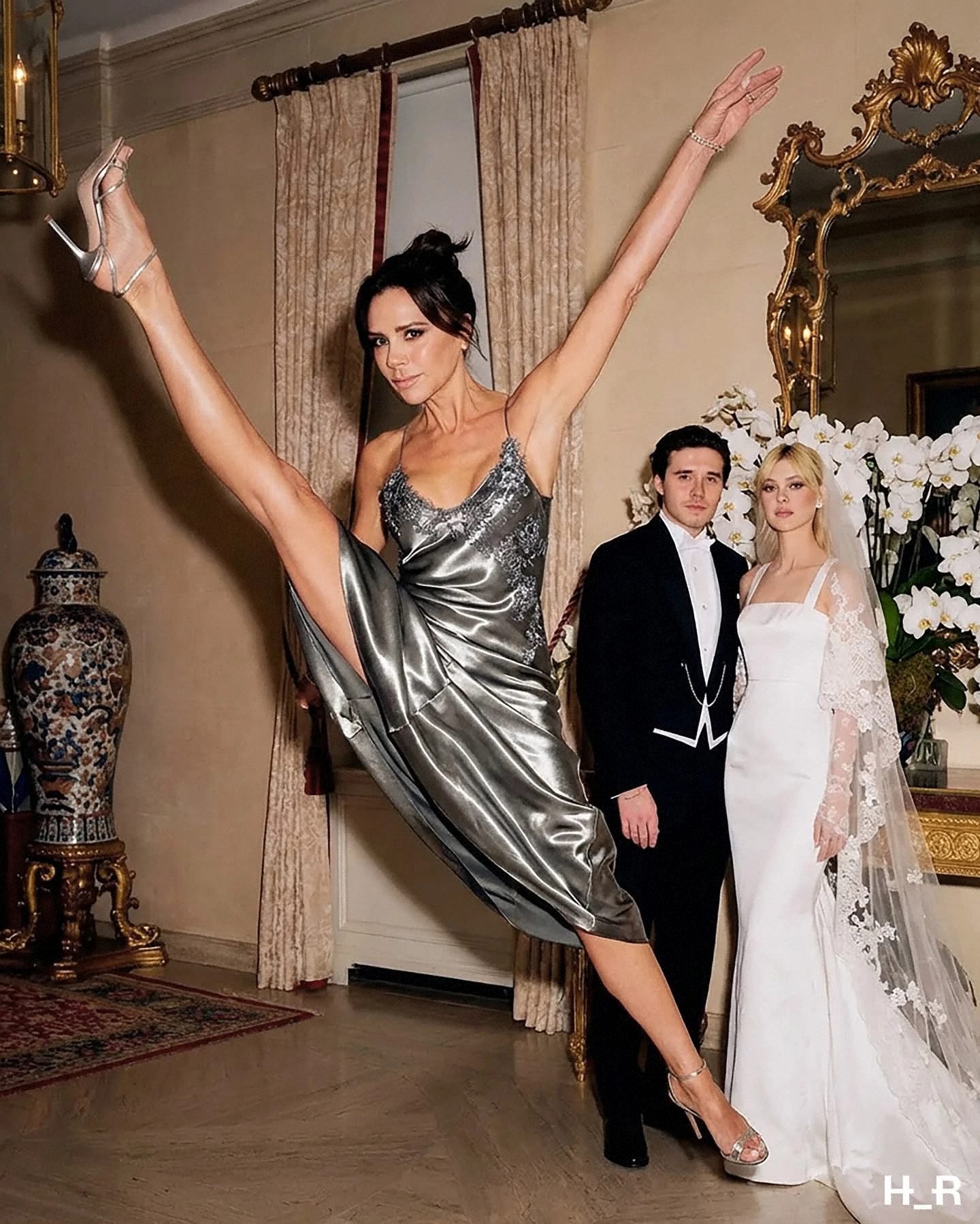
And we begin to change.
There are two ways this can happen.
We increase Fidelity: we get more detail, a greater resolution of the object from the same position
We increase Multiplicity: we broaden the range of positions from which we can encounter the same object.
When you see someone wearing a dress well, that is fidelity.
When you see someone using a scarf in a novel way, that is multiplicity.
The broader the range of ways we can perceive something, and the more detailed those perceptions are, the better our model of it becomes.
This is a core skill for how humans interact with reality.
In 2001, J. Kevin O’Regan and Alva Noë published A Sensorimotor Account of Vision and Visual Consciousness. Their argument challenges a simplistic model in which seeing means receiving sensory information and constructing an internal picture of the world.
Instead, seeing is something we actively do: we learn how sensory input changes as we move through and interact with an environment.
Perception is a skilful activity.
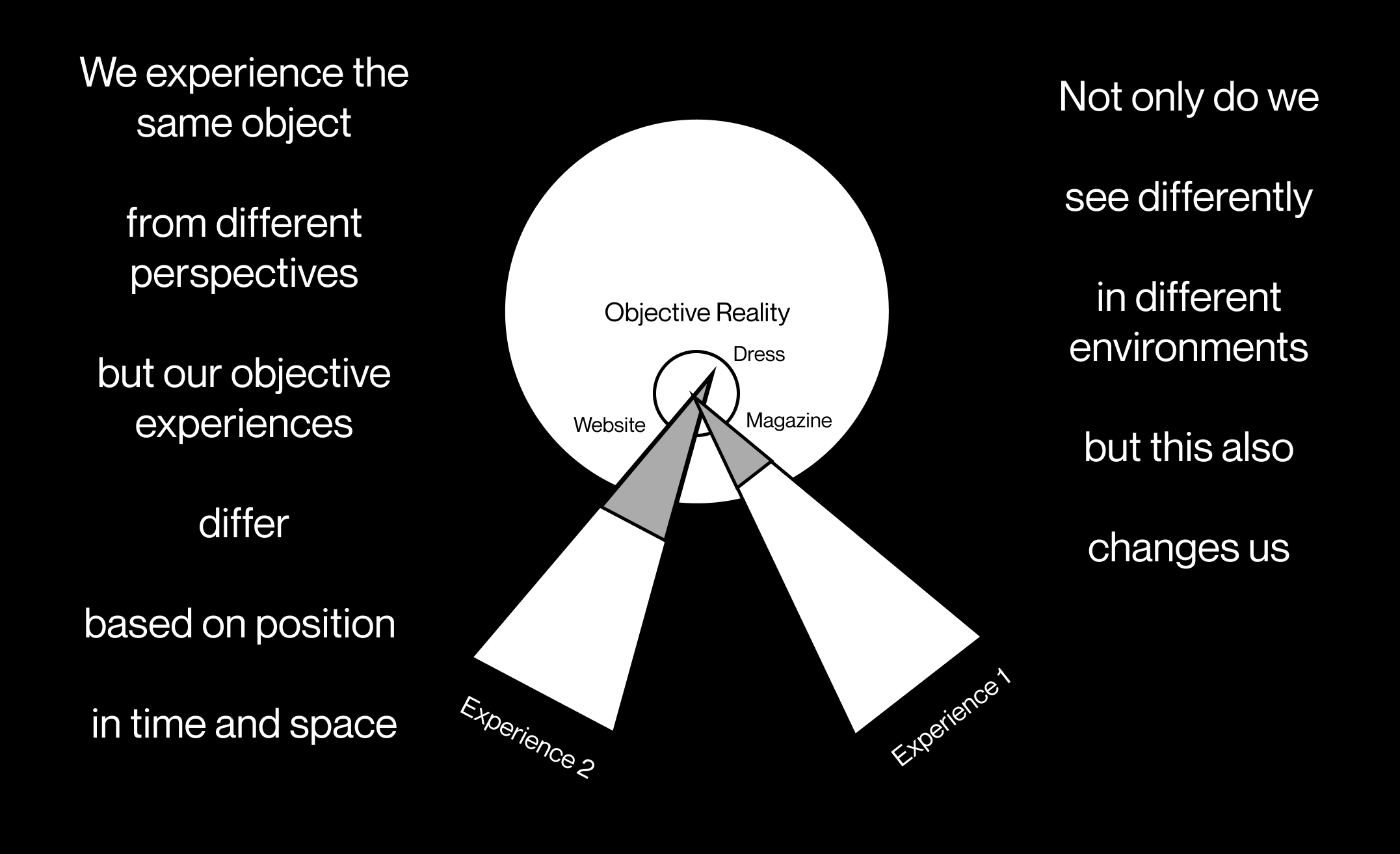
As new sensory information comes in, we assume we are learning more about the environment.
We forget that the environment is also changing us.
SALESSALESSALES
I head to the store and look at the dress.
Like any store with the ability to put its dresses in a beautiful magazine and on a beautiful website, the changing rooms are an improved experience.
I’m welcomed in.
The fanfare begins.
‘Russ is here and he wants to buy a nice dress.’
Out comes the hostess with a glass of champagne. She ushers me over to my changing room with its beautiful, soft flooring, and inside is the dress I’d seen in the magazine. How did they know!?
It’s been a hot day. The air conditioning is just right. I can feel the damp sweat of the outside air evaporate from me and I feel at peace.
The champagne slides down cold. The glass is great. I look around and there is a perfect place to set it down. As I place the glass down on the leather trim, it feels safe and secure.
I fold the dress’ fabric through my hands and feel the texture. As I calm down, a light aroma awakens my nose.
They must pump it through the space.
And rightfully so.
Now I feel beautiful.
I feel strong. I feel capable. I feel like there isn’t a decision I could make that would be wrong right now.

As I put on the dress, I think about the magazine. I think about how it felt when I looked at it.
You know what?
It looks exactly like I thought it would.
It’s beautiful.
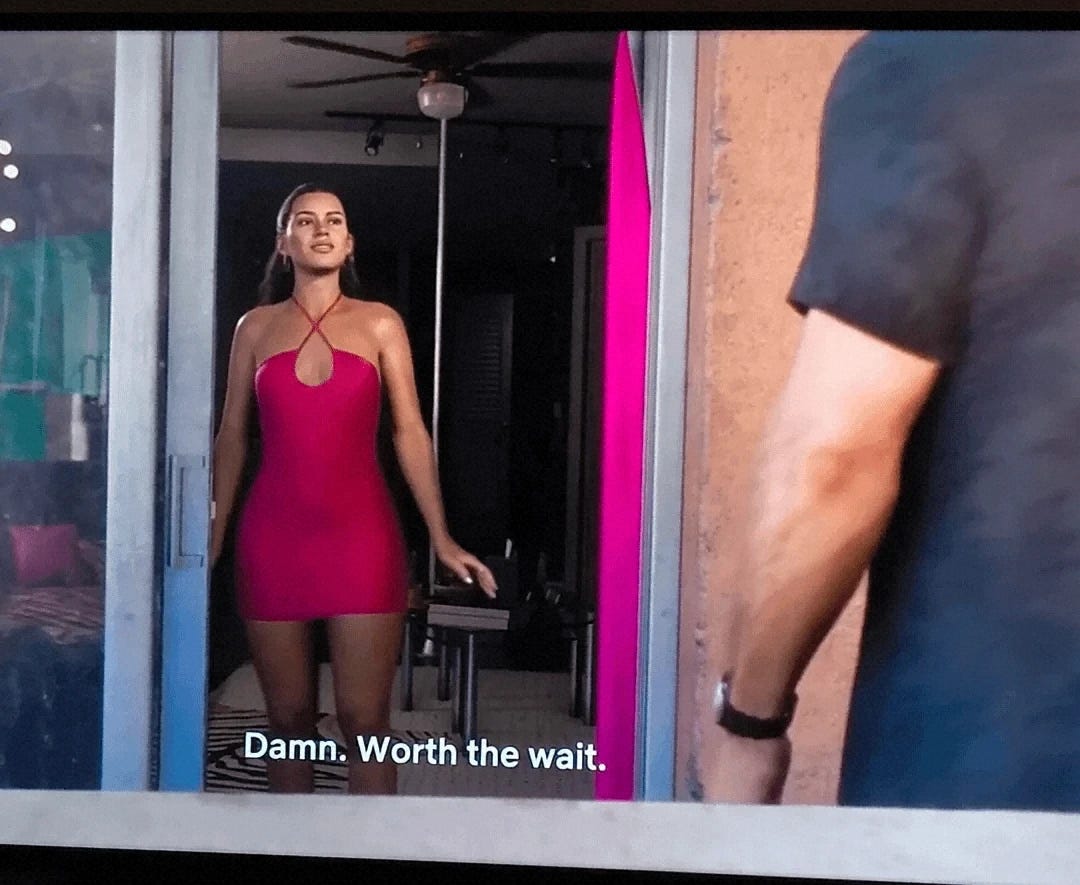
And so am I.
When I first saw it in that perfect lighting, the girl wearing it was significantly taller, skinnier and more beautiful than I perceive myself to be.
But I’d forgotten that was her, because now that is me.
The lighting in the changing room is astounding, but that’s not what I’m paying attention to now.
I’m looking at me.
Here, enclosed in this small room with this giant mirror that, for some reason, looks better than other mirrors I’ve seen before.
I feel good.
But it’s a mirror.
How different could it be?
Space
In 1977, Robert Irwin installed Scrim veil—Black rectangle—Natural light, Whitney Museum of American Art, New York at the Whitney Museum of American Art.
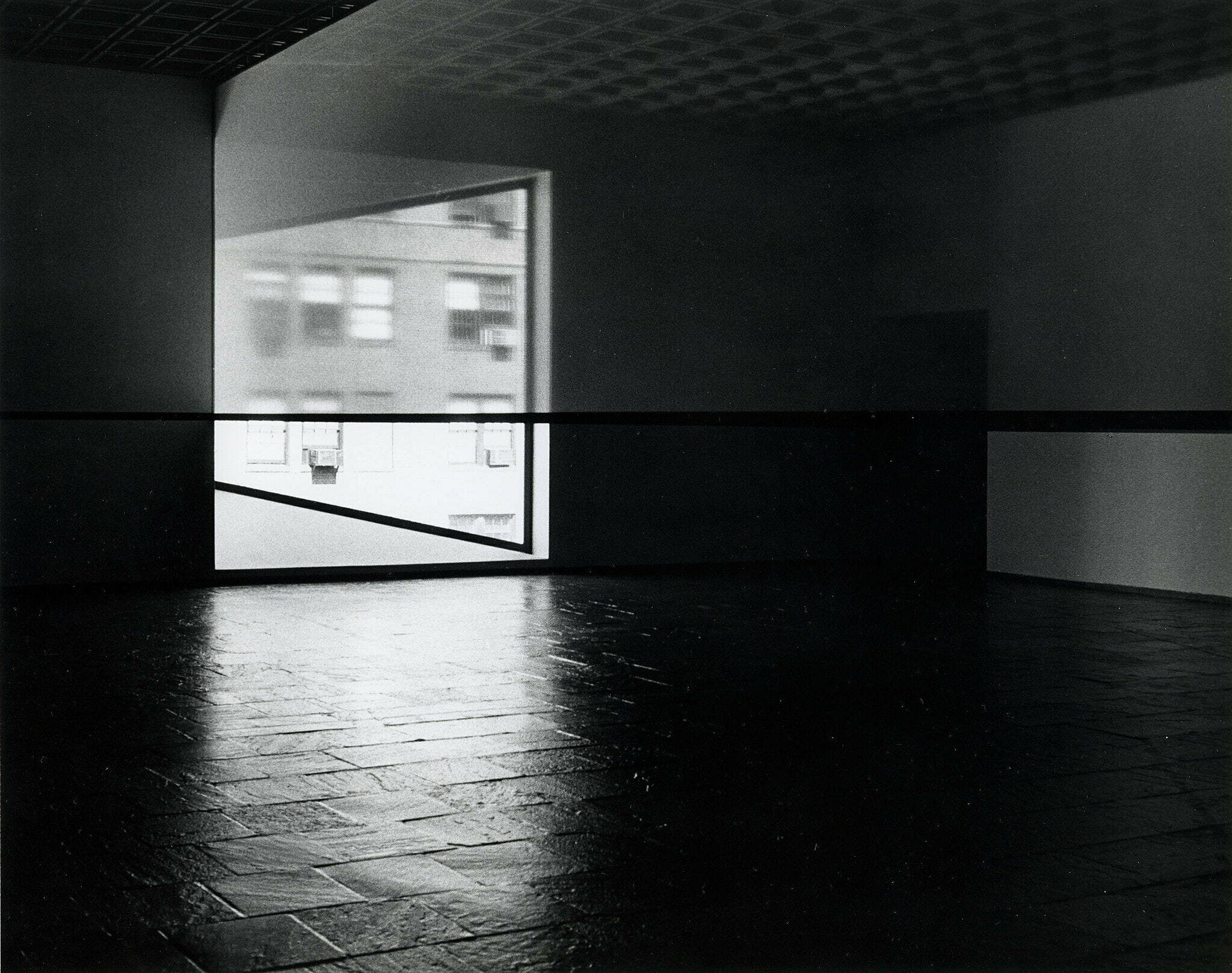
A sheet of white scrim dropped from the ceiling along the gallery, stopping at eye level. A black line circled the walls at the same height. Natural light entered through the gallery window.
Almost nothing was added, but the experience of the room had changed completely.
The environment is the experience.
I look at the label on the dress.
The numbers are more numerous and far higher than the ones I see in my bank account.
However, what I’ve learned about this dress since seeing it in that magazine, on my phone and right now in here is that it is very, very good.
In fact, there are probably no other dresses as good as this.
It is probably the best dress.
And this is probably a good price.
But I’m worried.
Maybe this is too much. Maybe this isn’t right.
I begin to think about the dress, but all I can think about right now is how good it is.
Everything I’ve experienced so far has told me so.
I’m in the changing room. I have no one with me. And I’m yet to think a negative thought about it.
But why would I?
It’s great. It’s perfect. It was in the magazine, it was on my phone, and now it’s here on me, and I feel amazing.
Training
In 2014, Christopher Summerfield and Floris P. de Lange published Expectation in Perceptual Decision Making: Neural and Computational Mechanisms.
Wordy, yes. Complex, maybe. Complicated? No.
The core idea is that we don’t encounter sensory information like a sensor. What we’ve already learned about the world generates expectations, and those expectations influence how subsequent sensory evidence is processed.
It might be easy to think that we’re experiencing the world by seeing, taking that information into the brain, deciding what to do with it, then acting on it.
But the system works both ways.
We navigate the world partly through predictions generated from what we’ve encountered before.
Our predictions shape how incoming information is processed.
The stronger the expectation, the less new information we need before settling on an interpretation.
Usually, that’s incredibly useful.
It makes us fast.
The problems begin when we no longer notice how much the prediction is shaping what we experience.

Ouroboros.
Brand
By the time I put the dress on, I’ve already decided what it is.
Well, actually, the brand has.
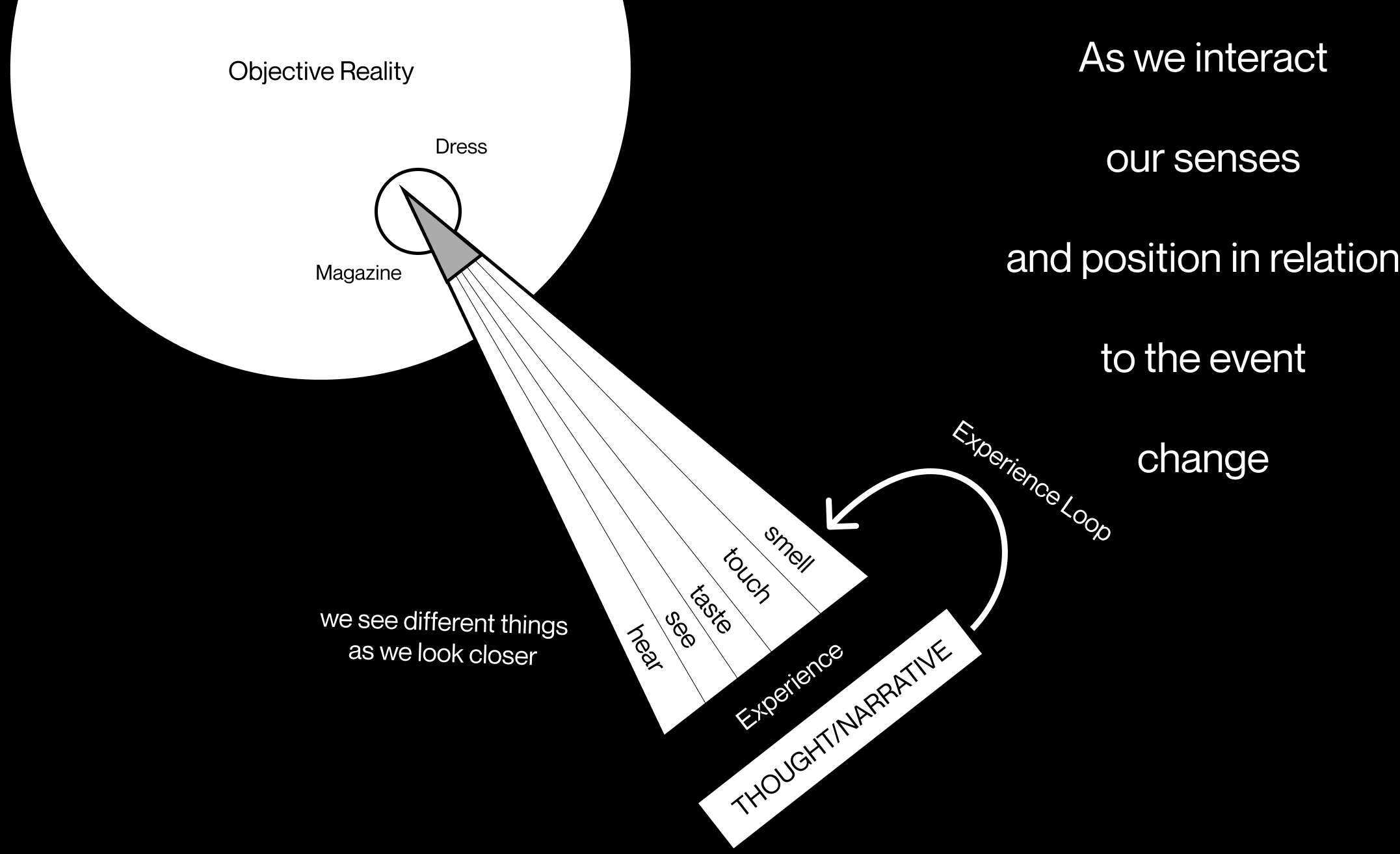
The website and magazine have built up an idea of how it should be perceived, and the changing room and sales professionals have told me everything I need to hear to make sure I walk away with it in my hands.
Each encounter I’ve had with the dress has changed me. My frame of reference has slowly tilted.
A new observer every time.
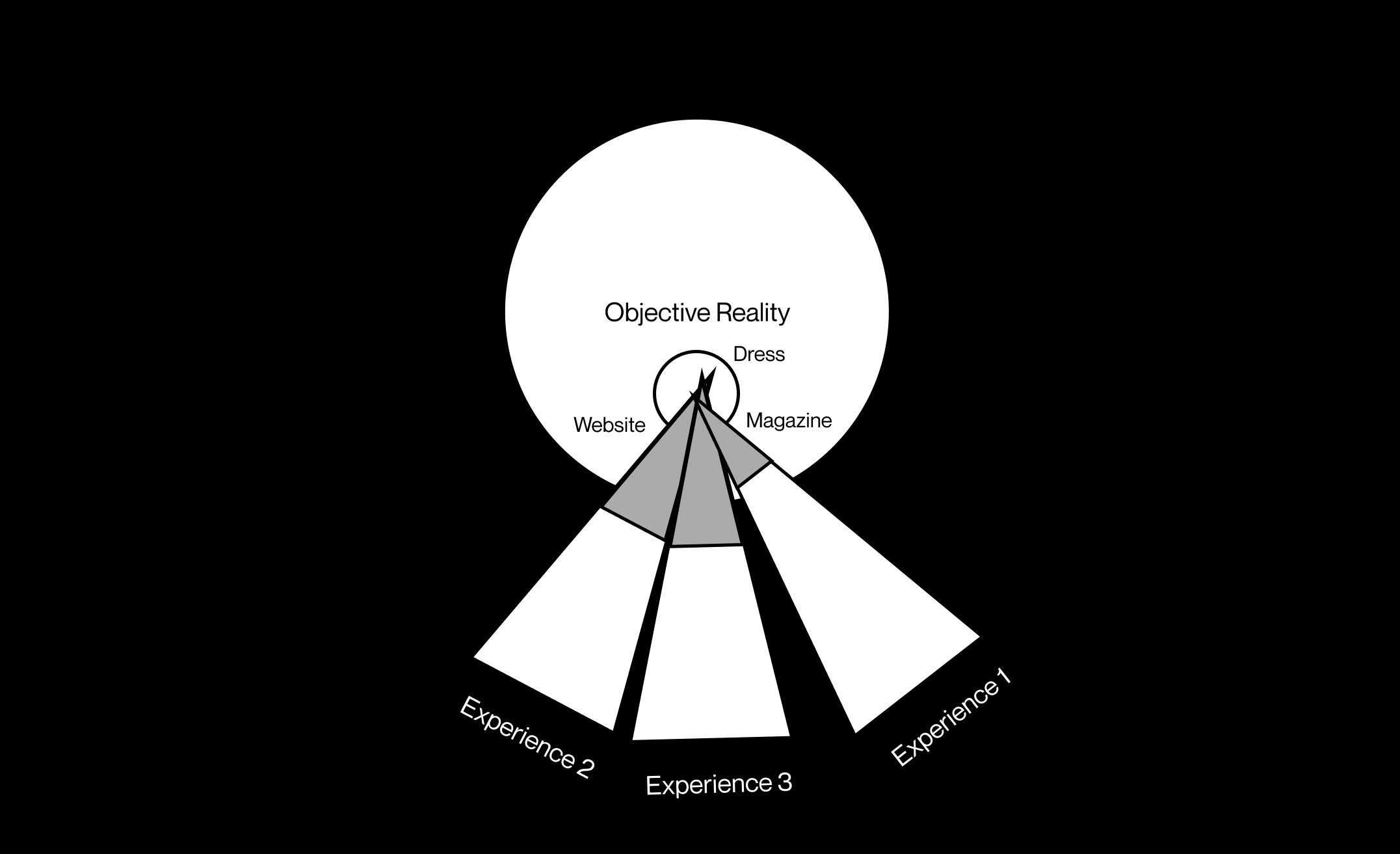
And there’s a problem.
More perspectives don’t necessarily mean more perspective.
The magazine, website and changing room appear to give me different experiences of the dress. But they have all been designed by essentially the same system.
I might think I’ve encountered the dress from three positions.
I may have encountered the same authored perspective three times.
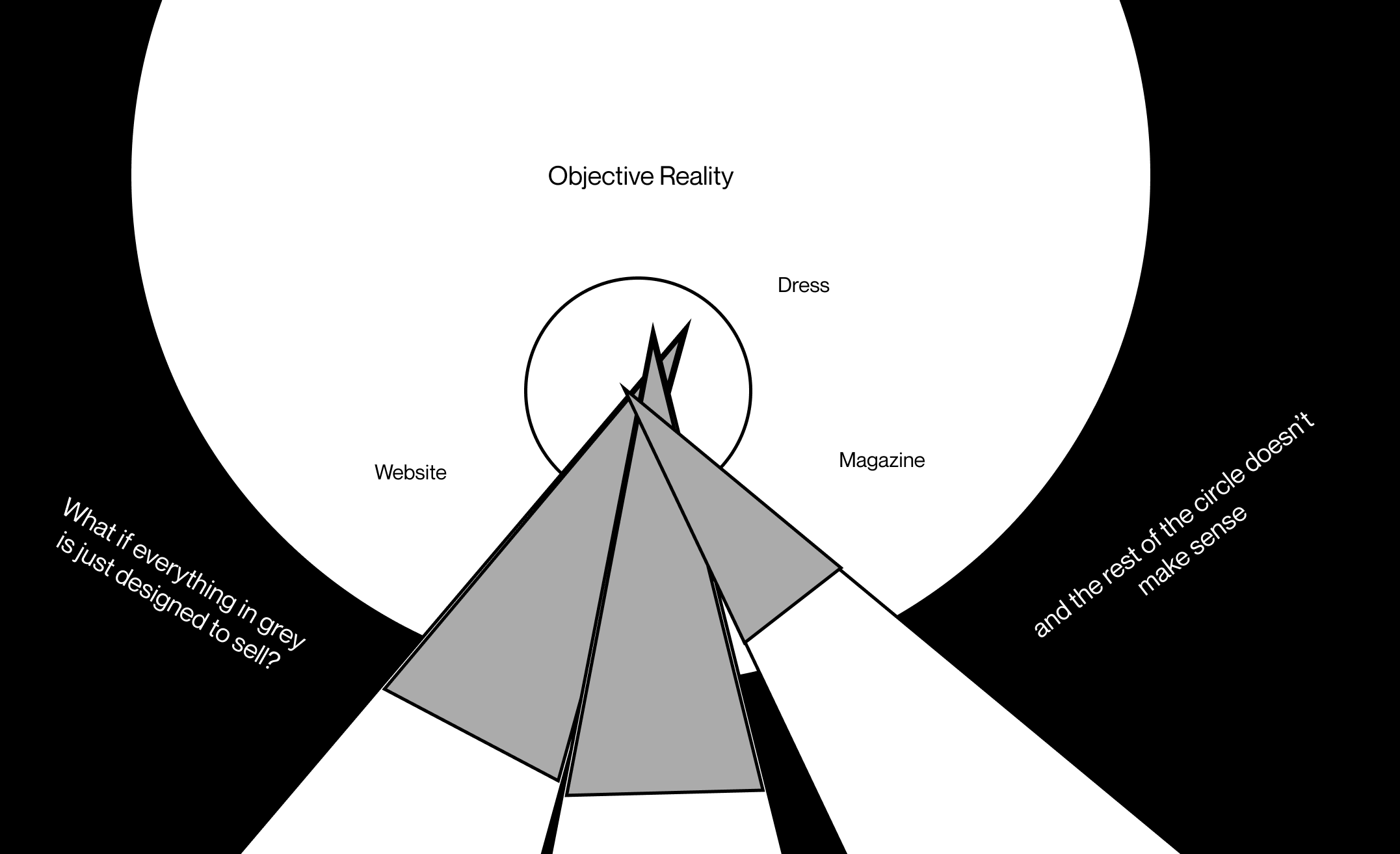
And as such, the dress is now in the bag and the credit card is in the till.
The exchange has happened.
The hostess smiles sweetly.
“Thank you, Mr Jones. It’s always great to see you. The dress looks fantastic.”
I hold it in my hands and step out the door.
Wow.
Great day.
I haven’t worn a dress before.
But tonight, at the party, I think it’s going to look good.
Perspective
Art has no requirement to be anything.
It is something that comes out of someone attempting to do it.
But from the viewer’s perspective, what it can offer is another position.
Art lets you look at something in a different way.
Sometimes that means changing the conditions under which something can be perceived.
In 1997, Olafur Eliasson made “Room for one colour”. Monofrequency light reduces the colours available to the eye and makes everything look like a yellow-tinted greyscale. Everything is still there, but most of the colour is removed and you only get contrast.
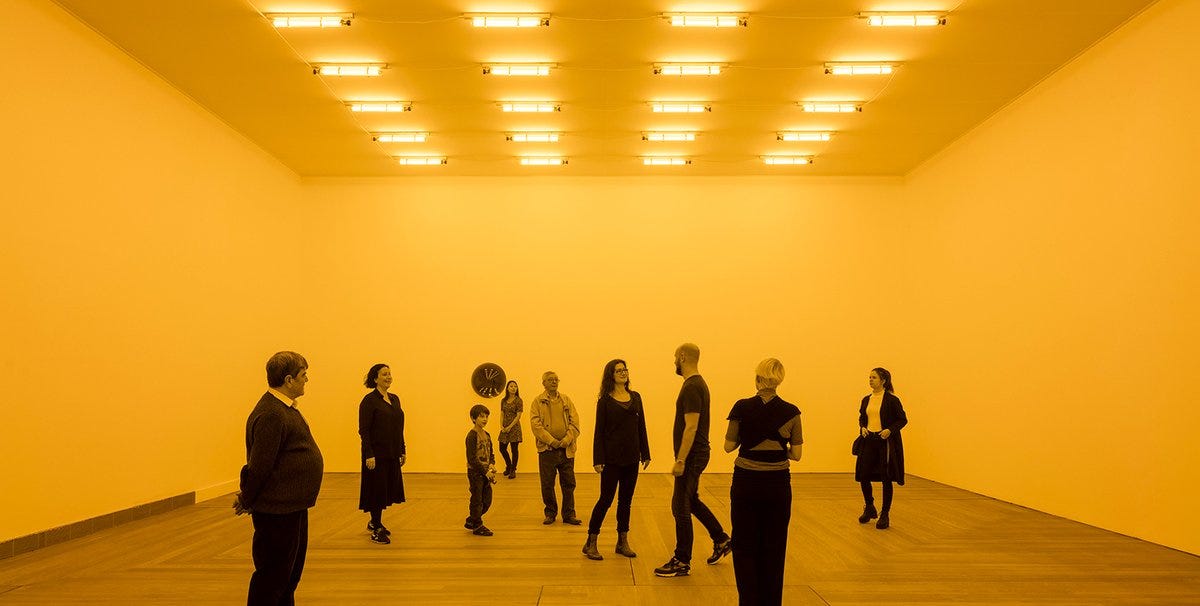
Maybe art gives you greater multiplicity: the same object from a novel position.
Maybe it gives you greater fidelity: the same object delivered in a way that lets you see detail you otherwise couldn’t.
Sometimes it interferes with the distinction between the thing and its surroundings altogether. Playing with what something actually is through deception.
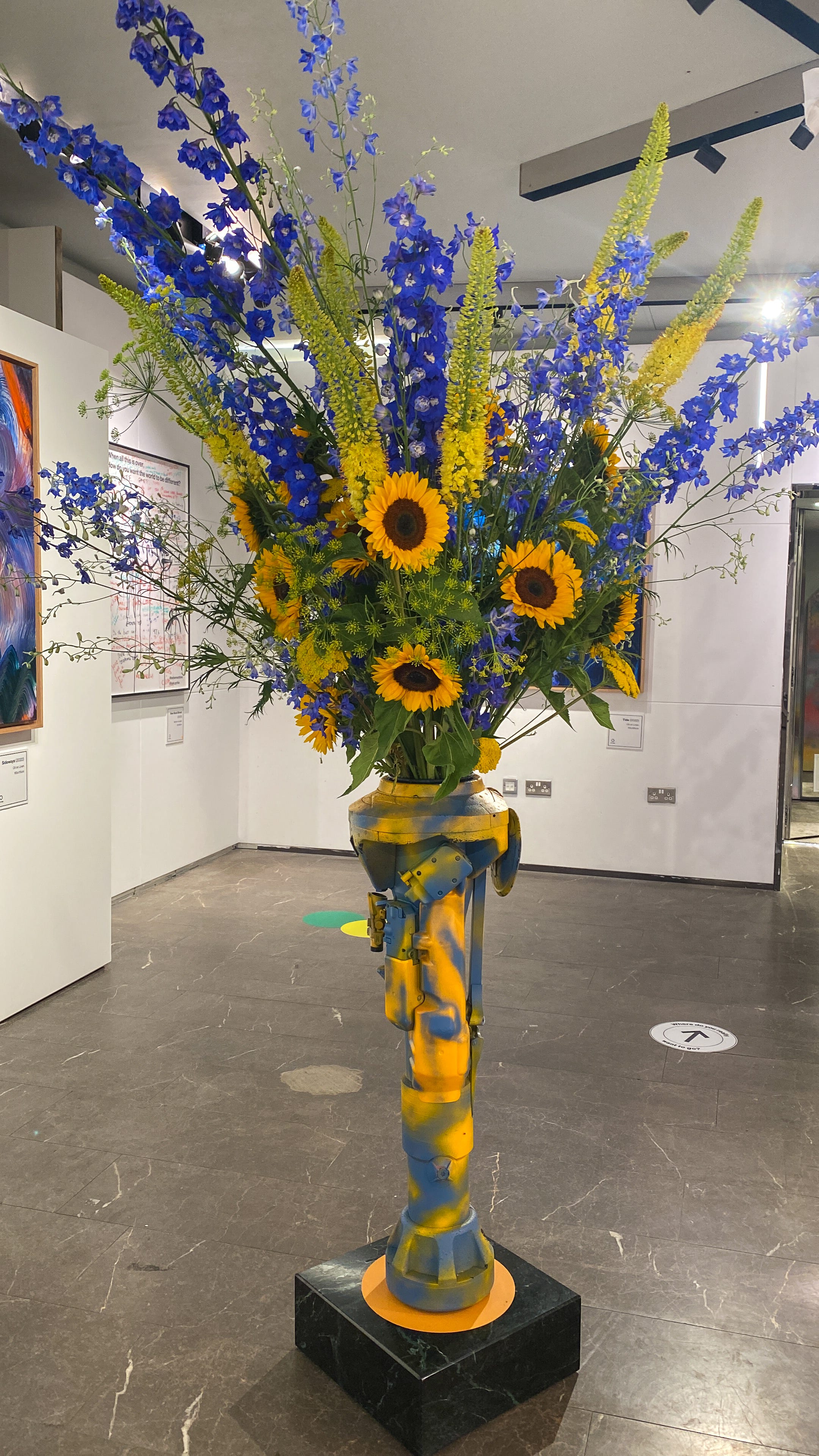
Or by creating an environment that is deceptive by nature. James Turrell’s Ganzfeld installations remove spatial references by flooding areas with light and colour, so the eye can no longer locate itself in space. While the objects haven't been materially changed, our ability to locate and perceive them is completely altered.
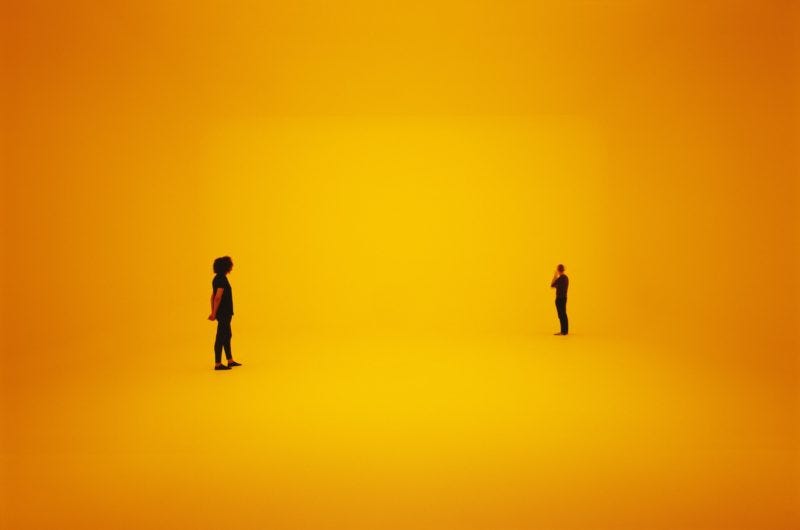
Across these dimensions lies much of the value I find in art.
We can argue whether something is new, whether it’s well executed, whether the craftsmanship is good.
But great art leaves the observer with a perceptual capacity they didn’t arrive with.
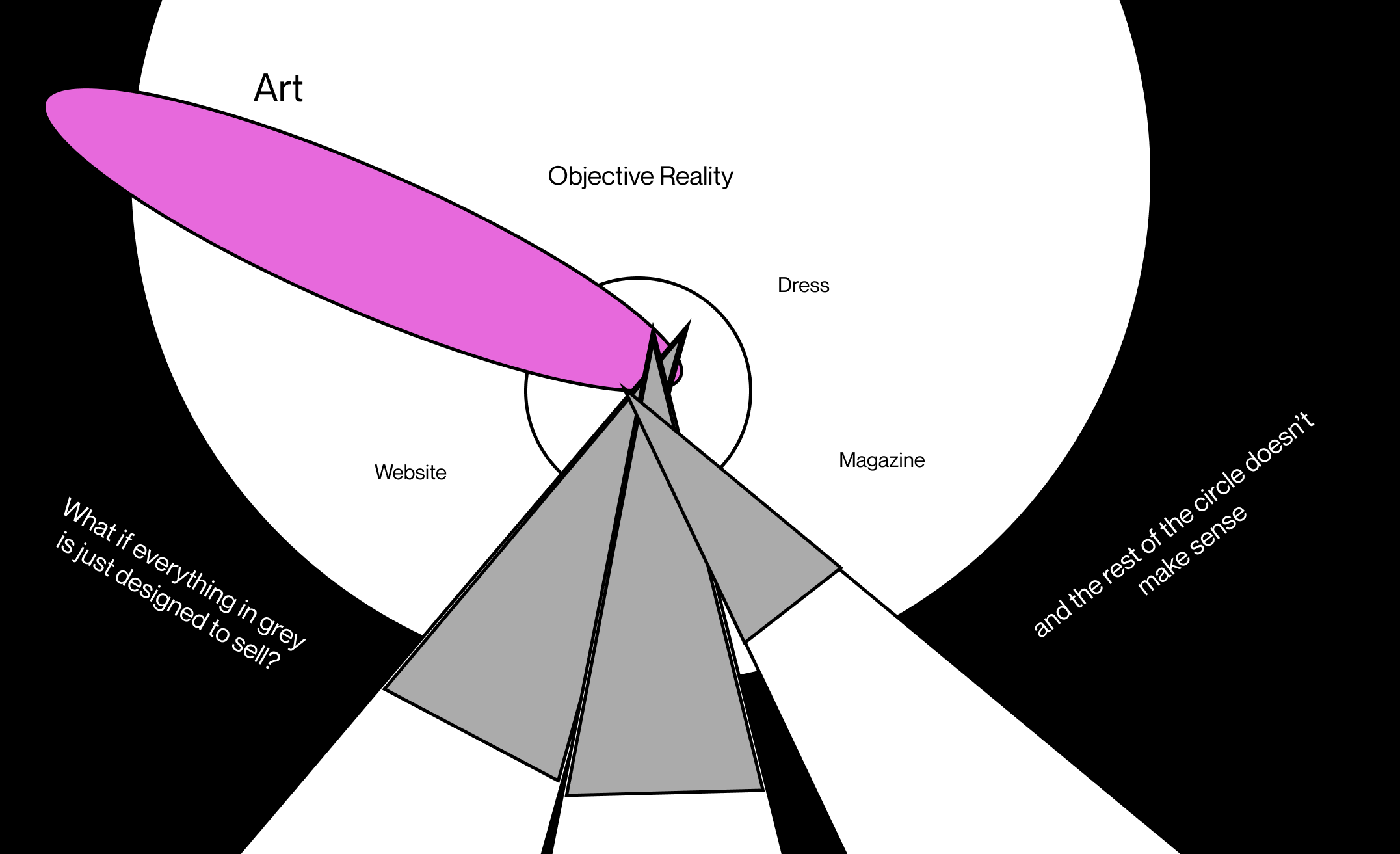
If you’ve been reading my work for a while, you’ll understand that I only have one real rule with art across all mediums: The artist’s role is to create a frame of reference, and keep the viewer within it.
That frame is the artist’s perspective.
Great art pulls us into it.
And sometimes, we leave seeing differently.
Art creates perspectives.
Perspectives create perceptual experiences.
Experiences update observers.
Updated observers perceive what comes next differently.
Tonight, I’m wearing a dress to a party.
And so far, everything I’ve said has only involved one observer.
Me.
But reality isn’t experienced alone.
Eventually my perspective has to encounter yours.
Next week: consensus reality.
Final Words
I hope you’re following what I’m trying to do and that it’s useful.
And that the little things I’m learning every week help you as much as they help me.
This coming week I’m going to be putting out a little bit more video content and trying to share some of these things in a more easily consumable manner on socials.
And if you’re in Vauxhall on the 26th of September, I’m having an open studio where I’ll probably turn the studio into an installation exploring some of these concepts.
I don’t know. Let’s see.
It’ll be fun.
Anyway, peace and love. Hope you have a great day.
Your obedient servant,
Russ.