


Just like the monsters under the bed,
the pain doesn’t arrive
until you admit it exists.
Like a mosquito that buries itself in your skin.
We are completely unaware
of how much damage is being caused
until the damage is done,
blissfully unaware
until we begin to scratch.
Clawing at the infection that has begun.
Maybe she was never mine.
My attachment to those words,
to that idea,
to this thing that never really existed,
is this the cause of all the pain?

Maybe I’d convinced myself so completely of what could be, what should be and what would be delivered, that now, faced with the reality of my world, I find myself far from those ideas. And that is why I’m hurt.
Because the reality is that whatever I thought it could be, whatever I wanted it to be, was never something that was within my gift. Because the only thing that I have is now. And when I look around, she is not here.
You see, we play it out, we say it out. We want it to be this endless perpetual moment. Feel the high and maintain it forever. But the reality is, if you could, you would. And if you don’t, you won’t.
So if the light only stays on for a second and then it goes somewhere else? Then maybe that’s what it is. A light for someone else.
And as much as you might think that it will come back, and you can say those words to yourself, and create all the ideas and stories and plans that bring that light back, and make it shine as bright as you know it can shine, for as long as you want it to, in front of you, just as you always dreamed, just as it did once before. You know these are just stories, just ideas. And you will become addicted to them just as I have. Because they are as intoxicating as whatever you think that light is. But they keep your room dark.
And when you’re faced with the reality that is this, when it’s finally time to realise, you’ll be carrying all the sheaves of paper, all your stories and ideas, all those memories of the future where you said you’ll see the light one more time and everything will be okay. You will look up and you will say, “but where’s the light?” And when you finally notice that it is still somewhere else. Then the only thing you’re gonna be able to do, to keep yourself warm, is set fire to those papers, until even the stories are no more.
But at least you’ll have light.
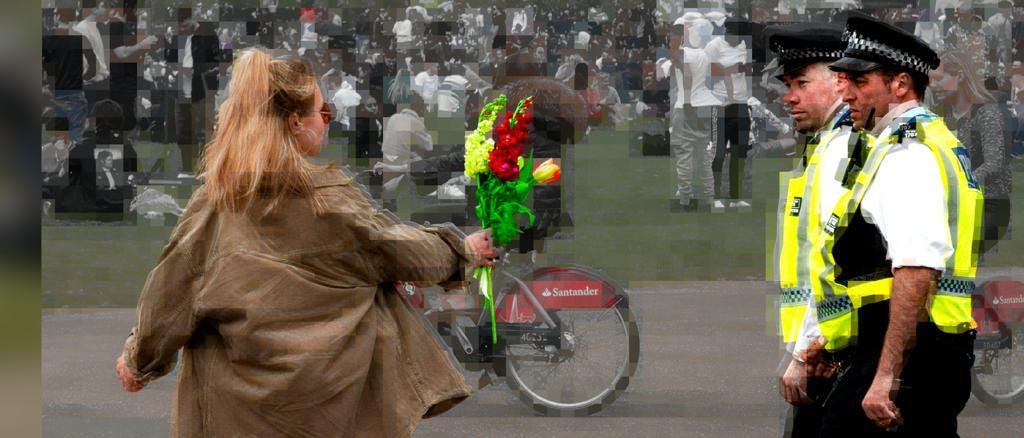
Why is a policeman in charge?
The policeman’s in charge because I say he is.
Because I have given him the power.
The narrative.
The story.
The word Police comes from the Latin politia, which is simply ‘civil administration’. It comes from the Greek ‘polis’. The city. A policeman is the city’s man. A policeman becomes the figure through whom the city speaks.
I remember growing up watching a terrestrial television series called The Bill. I remember the music. I don’t remember the stories. I remember it being infectious to my family. I remember thinking how attractive everyone was. The state has always played a role in their city’s man, in how they manufacture the identity of a policeman. In how they make sure it’s something seductive, something with weight. We’ll look at the state’s role next week, but this week I want to focus on the power of the noun.
When we define a noun, when we define a thing, we attach all of our ideas to it. A partner. A lover. A girlfriend. A boyfriend. ‘Someone’ I care for. ‘Someone’ I know. This is my ‘friend’. All of these things define our relationship to someone. How we perceive them. How we want others to perceive our relationship to them. And the more we compound these ideas, the stronger that identity becomes. It doesn’t matter whether we have a positive or negative relationship to the nouns that we define as individuals. Just that we use them.
I’ve been testing this out for a few weeks now. Listen to the nouns that people say around you. Listen to the things that people reference, and you’ll notice something. You’ll notice that what they are trying to say is: I am close to this thing. It affects me. See us together. Every noun establishes a relationship between the speaker, the object and the listener. In status environments, that relationship becomes a form of positioning. Pass me the paintbrush. They can use that resource. This is my friend. I am similar to this person. Would you like to see photos of my dog? I like photos, I have a dog. If you’ve ever felt the sting of infidelity, it’s normally the clearest sign. A partner mentioning someone’s name a little too much. The way they say it. Why? Something trying to get out?
We often use nouns to define ourselves because we have a weak sense of self. When our own identity isn’t strong enough for the environment that we’re in, or the tasks that we’re doing, we use roles, institutions, nations and relationships to give the self a structure it cannot yet produce alone. Announcing this to the world, and associating ourselves with those things, gives us resources and strength. Real or otherwise.
Watch people at networking events. The weaker characters will define themselves with the nouns that don’t reflect their value. They’ll use nationhood, industries, roles, accolades. The nouns they value in their industry, the jargon, the brands. Words that say nothing about who they actually are, all deployed to establish how successful they are, because they see those ‘things’ as more powerful than them. It’s the same as when you meet people who name-drop their contact list. Yes, they have proximity, but they also have an insecurity that tells you they do not believe they are enough. Maybe they’re right, maybe they’re not. Maybe that’s their decision, and every time they use someone else to prop themselves up they are contributing to their own demise. And maybe if they just believed in themselves, they wouldn’t need any of that stuff anymore.
Roles
I’m still not sure what the hell I do within the world. But the nearest conceptual reference that I have is that I am an artist. The unfortunate reality of that moniker is that it is attached to an economic system that isn’t quite how my system works. Equally, it’s attached to a social prerogative that assumes my day-to-day life mainly revolves around the painting of still lifes or portraiture. It’s a very confusing term for me to use in most environments. But it’s just about good enough to define what I do, given there isn’t a better one. And the reason I became someone that used it is because I wanted what I thought the artist had. Freedom. What better archetype for someone that’s trying to figure something out than the character that already has it.
The same system applies to our enemies and foes. We define ourselves by them. By their scale, by their relevance. If I challenge a government, my ego is placed on the same level, and that can be intoxicating. The police fight crime, crime is bad, therefore the police are... Just as The Joker is defined through his conflict with the Batman, our antagonists are still things that we are close to, that we are defined by. And our referencing of them indicates their influence on us and our requirement to be defined by them. A little like how a recovering alcoholic is still defined by the substance even when they’re ten years sober. Identity can form around the conflicts we define ourselves by.
Corporate dogs
A friend once told me there are two really interesting facts about how McKinsey operates. It’s not the biggest company in the world, but what it does have is identity. The first is that when you work there, you never reference the competitors. Boston Consulting Group and Bain do not come up in conversation. What I noticed when I was at BCG was that the competitor firms would surface in polite conversation all the time. At McKinsey this wouldn’t be allowed. A refusal to say the noun. Starve the name and you starve its power. Refusing to pronounce a competitor’s name denies them space inside the organisation’s internal reality. (The second was the idea that merch is brand dilutive. They don’t make any. It’s likely why most artists should be careful with novel mediums such as merch, and also why it’s so impressive that Ye built in this medium to such success alongside music. But all for another day.)
Notice what I did there. Look at the nouns that I’ve used. I have decided to reference others to position myself closer to them. There should be no requirement for me to do this. I began with corporate institutions, probably got insecure, and then tried to reposition myself near unconventional artists. There’s some underbelly of status too… all of it based on my need to be perceived as qualified to say what I’m saying.
Polis
Those that reference the policeman place it in power.
“I’ll call the police.”
By virtue of how they’re referred to, the line that we draw towards them, and the situations in which they are called, the connotations of the word act as a flywheel. A feedback loop that feeds in on itself. And with that power, there becomes an identity.
“I’ll call the police.”
Said in a moment of panic. We watch them arrive and fix the situation with weapon systems and care. They then take that same power system and place it into a space where they shouldn’t necessarily have it. Innocent questioning on a polite day. Asking for your personal information at a protest. Asking you to do things that you might not otherwise have felt were appropriate. They are able to leverage that power in another space through the shared identity.
It’s the civilised equivalent of saying “don’t you know who I am?”
Masquerade
I’ve felt the feeling of losing the name. I was running a counter-poaching operation in Uganda, and then two days later I was sleeping on the streets of Paris at Christmas with nothing but a blanket and a ticket home. In Africa I had a team: doctors, experts in counterinsurgency. Autonomy, weapons, free rein, a direct line to the government. Complete power. And on the streets. Nothing. No uniform, no resources. Exactly the same person, but despised for no reason other than I didn’t look like someone important. That loss of status is still one of the most painful experiences of my life. But it taught me how little of me was actually important once the uniform society had given me came off. Everyone has this experience eventually. Some will fight it when it happens, others will embrace it and realise. It took me a while to put it all together, but now it’s pretty clear.
The world is a masquerade ball.
Wear the appropriate uniform.
Use the right name.
And make sure people know it.
Name
The policeman is really powerful because we’ve been using the word for so long. We think it means a certain thing. We think it means it’s going to help. Depending on where you live and your experiences so far. But generally, in most cases, that is your port of call in an emergency. This is who you call when you are in danger. Who else are you gonna call? If it’s not the police, it’s someone who can provide the same level of service. Maybe it’s someone that can deliver violence, or maybe it’s a lawyer. But most people in the world don’t have protection or a lawyer on speed dial. Only those that understand that the police aren’t the only solution. That the police are a lower enactor of the real powers of society and reality. The powers that attribute power to the police. In our case, the legislature. Once again, for another week.
But right now, what I want to focus on is how we define the police. What is the context in which the police are presented? And who is able to do that?
Watch how the police are being documented right now. Daily clips of success, same in the US and UK. Phone footage, bodycams, social media edits. Whatever you think of each one, notice what it is doing. It is redefining the noun and maintaining its effect. The police force is as much a media organisation as it is a technical one.
Communities have always done this. When Robert Peel put the first uniformed police on London’s streets in 1829, the crowds renamed them. Raw Lobsters. Blue Devils. Peel’s Bloody Gang. Eventually these reduced to the one we still hear today. Bobbies. It’s not meant as affection. It’s a diminutive. Over time, because of its softer sound, the police embraced it. We find this in every community around the world that has a difficult relationship with the police. They find a new way to define them that fits their perspective. The feds. The black and tans. Five-o. Pigs. All of them new nouns for a group that holds power. Nouns that let you establish a relationship to it that’s more coherent with how you see it.
All this to say.
The policeman’s in charge because I say he is.
So what happens if I stop saying it?
Keep the uniform.
Keep everything else.
Get rid of the rank.
Just call him by his name.
“Frank.”
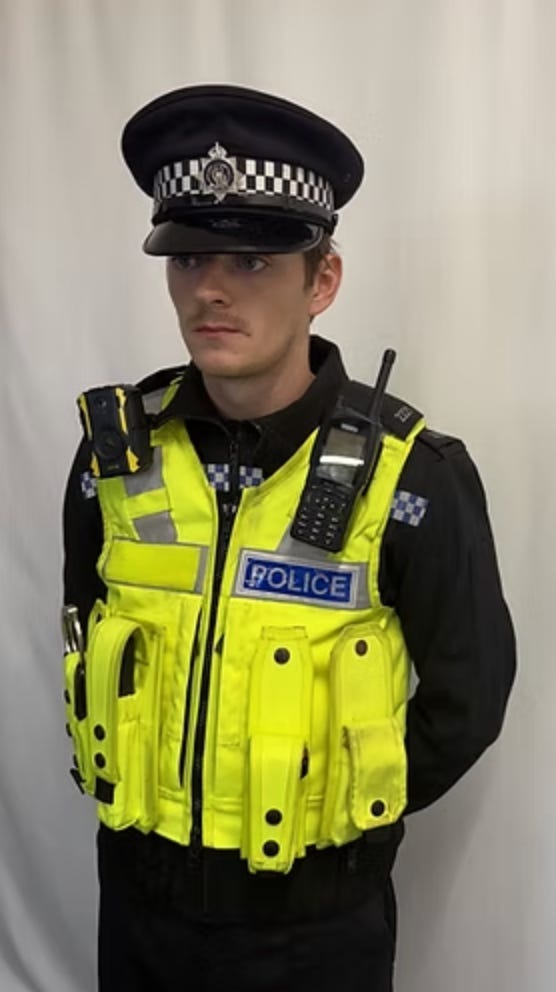
How powerful is Frank now?
And what is it within the name that gives it power?
Final words
Over the next few weeks I’ll be staying in this same orbit. I’m not sure when I’ll leave, but I have some ideas of how this feeds into the practical side of my work that most of you know me from.
If this is your first week here, welcome to the other side of the art world.
You came just in time.
I hope you enjoy this as much as I do,
love you loads
r x